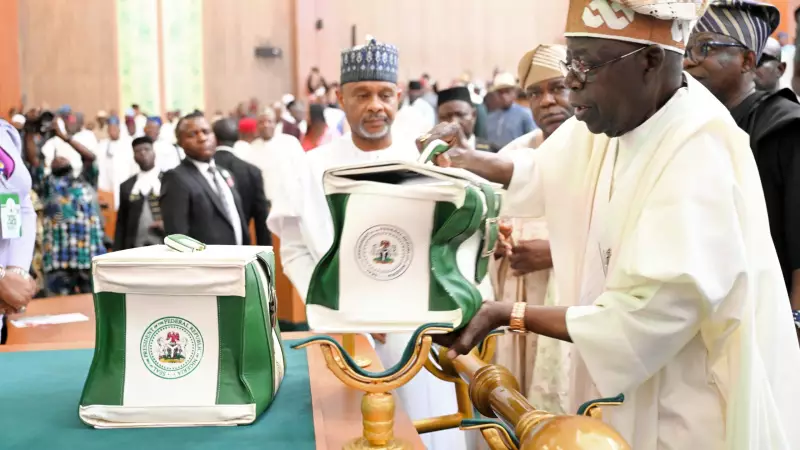
In a dramatic fiscal maneuver with just 13 days remaining in the 2025 financial year, President Bola Ahmed Tinubu has formally requested the National Assembly to scale down the current year's budget by over N6 trillion. Simultaneously, he presented a N58.18 trillion spending plan for 2026 and issued a stern declaration classifying all armed non-state actors as terrorists.
Major Budget Revisions and Extension Request
The president's requests were detailed in a letter dated December 18, 2025, read by the Speaker of the House of Representatives, Tajudeen Abbas, on Friday, December 20. President Tinubu transmitted the Appropriation (Repeal and Re-Enactment) Bills for both 2024 and 2025 to the lawmakers.
Under the proposed revisions, the 2024 budget of N35.06 trillion would be increased to N43.56 trillion. More strikingly, the 2025 budget of N54.99 trillion would be significantly reduced to N48.32 trillion. The president also sought approval to extend the implementation of the 2025 budget until March 31, 2026.
This move is directly linked to a severe revenue shortfall. The Minister of Finance and Coordinating Minister of the Economy, Wale Edun, recently revealed that the Federal Government generated only about N10.7 trillion in 2025, a figure far below the projected N40.8 trillion. Edun blamed weak performance in the oil and gas sector and underperforming revenue streams for the gap.
President Tinubu argued that revising the budget timeline would ensure the full release of the 30 per cent capital allocation target for Ministries, Departments, and Agencies (MDAs), thereby addressing the chronic under-execution of capital projects seen in previous years.
The 2026 "Budget of Consolidation" and Security Stance
On the same day, President Tinubu presented the N58.18 trillion 2026 Appropriation Bill, themed "Budget of Consolidation, Renewed Resilience and Shared Prosperity," to a joint session of the National Assembly.
In a significant security policy announcement, the president declared that all armed non-state actors operating outside state authority would henceforth be classified as terrorists. This is part of his administration's push to tighten Nigeria's security architecture alongside consolidating economic reforms.
Tinubu pointed to signs of economic stabilisation, citing an economic growth of 3.98% in Q3 2025 and a decline in headline inflation from 24.23% in March to 14.45% in November 2025. He also noted that external reserves had risen to a seven-year high of about $47 billion.
Fiscal Details and the Challenge of Overlapping Budgets
The 2026 budget projects total revenue of N34.33 trillion against an expenditure of N58.18 trillion, leaving a substantial deficit of N23.85 trillion. Key allocations include:
- N5.41 trillion for Security
- N3.52 trillion for Education
- N2.48 trillion for Health
- N26.08 trillion for Capital Investment
The budget is based on an oil price benchmark of $64.85 per barrel, daily production of 1.84 million barrels, and an exchange rate of N1,512 to the US dollar.
However, a critical contradiction emerges. If the National Assembly approves both the extended 2025 budget and the new 2026 budget, Nigeria will once again operate two budget cycles simultaneously. This perpetuates a problem the president identified as complicating fiscal planning and delaying projects.
This practice has become commonplace. In 2024, the country ran three budgets concurrently. In 2025, it has been operating both the extended 2024 budget and the main 2025 budget. President Tinubu's letter stated the new bills are designed to end this very practice, aiming to strengthen planning, execution, and accountability.
The president has directed the Minister of Finance and heads of agencies to enforce strict budget discipline, warning against leakages and inefficiencies. He also announced a full digitisation of revenue mobilisation to improve transparency and performance tracking.