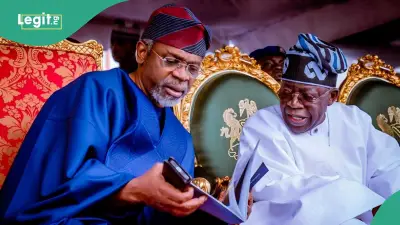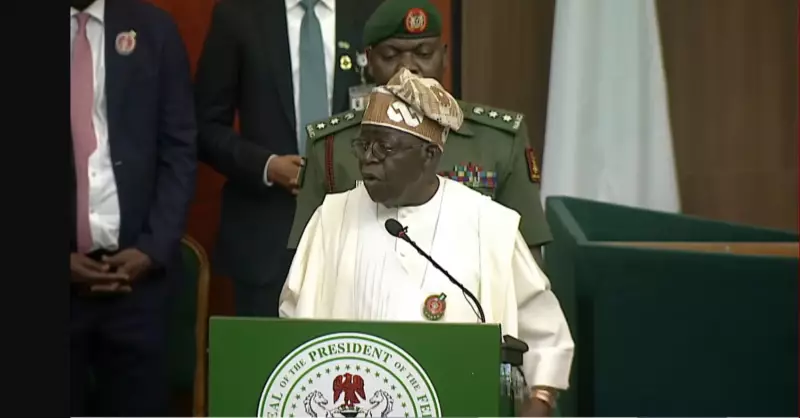
President Bola Ahmed Tinubu has formally presented the 2026 Appropriation Bill to a joint session of the National Assembly in Abuja. Dubbed the "Budget of Consolidation, Renewed Resilience and Shared Prosperity," the fiscal plan outlines a total expenditure of N58.18 trillion for the upcoming year.
Economic Context and Budget Philosophy
In his address on Friday, December 19, 2025, President Tinubu framed the budget as a critical step in solidifying the economic reforms undertaken by his administration over the past two and a half years. He acknowledged the hardships faced by Nigerians but asserted that the difficult policies were beginning to yield positive results.
The President pointed to key economic indicators showing progress: GDP growth of 3.98% in Q3 2025, a decline in headline inflation to 14.45% in November 2025 from a high of 24.23% in March, and external reserves rising to a seven-year high of about $47 billion. He stated the 2026 budget is designed to lock in this macroeconomic stability and ensure growth translates into tangible benefits for citizens.
"Our task now is to consolidate these gains—so that stability becomes prosperity, and prosperity becomes shared prosperity," Tinubu told the lawmakers.
Key Allocations and Fiscal Framework
The budget is built on a conservative oil price benchmark of $64.85 per barrel, a daily production estimate of 1.84 million barrels, and an exchange rate of N1,400 to the US dollar. Total projected revenue is N34.33 trillion, leading to a significant budget deficit of N23.85 trillion, or 4.28% of GDP.
Major sectoral allocations highlight the administration's priorities:
- Defence and Security: N5.41 trillion
- Infrastructure: N3.56 trillion
- Education: N3.52 trillion
- Health: N2.48 trillion
Capital expenditure is pegged at N26.08 trillion, while recurrent (non-debt) spending is N15.25 trillion. A substantial N15.52 trillion is allocated for debt servicing.
A New Security Doctrine and Human Capital Focus
President Tinubu announced a sweeping new national security architecture. He declared that any armed group operating outside state authority would henceforth be classified as terrorists.
"The denominator is that if you wield lethal weapons and act outside the state’s authority, you are a terrorist," he stated, listing bandits, kidnappers, and their enablers—including financiers and even complicit community leaders—as falling under this definition.
On human capital, the President noted that over 418,000 students have been supported through the Nigerian Education Loan Fund. He also highlighted that healthcare investment constitutes 6% of the total budget size, net of liabilities, and welcomed a recent commitment of over $500 million in grant funding from the United States for health interventions.
Commitment to Discipline and Delivery
Admitting challenges in the execution of the 2025 budget, where only about 17.7% of the capital budget was released by the third quarter, Tinubu promised stricter discipline for 2026. He issued directives to key finance and budget officials to ensure implementation aligns with appropriated details and timelines.
A major focus will be on improving revenue collection, particularly from Government-Owned Enterprises (GOEs). The President mandated heads of GOEs to meet assigned revenue targets, supported by an end-to-end digitisation of revenue mobilisation to curb leakages.
"The greatest budget is not the one we announce. It is the one we deliver," Tinubu concluded, urging collaboration with the National Assembly to fulfil the promises of the Renewed Hope Agenda.