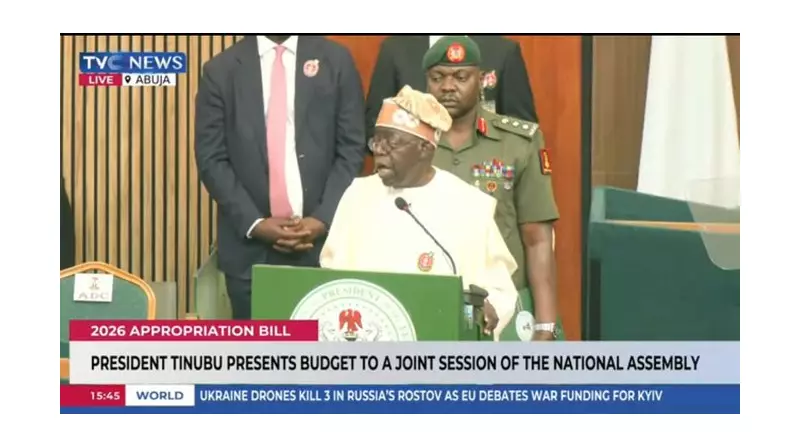
President Bola Tinubu on Friday, December 19, laid before a joint session of the National Assembly a historic N58.18 trillion Appropriation Bill for the 2026 fiscal year.
The President, during his presentation, christened the spending plan the 'Budget of Consolidation, Renewed Resilience and Shared Prosperity'. He framed it as the result of two and a half years of difficult but essential reforms designed to place Nigeria on a path of macroeconomic stability and inclusive growth.
Key Financial Highlights of the 2026 Budget
The fiscal blueprint outlines a total projected revenue of N34.33 trillion against a total expenditure of N58.18 trillion. This creates a significant deficit of N23.85 trillion, which represents 4.28 per cent of the nation's Gross Domestic Product (GDP).
A substantial portion of the expenditure, N15.52 trillion, is earmarked for servicing the country's existing debt. Recurrent non-debt spending is set at N15.25 trillion, while capital expenditure, crucial for building infrastructure, receives a larger allocation of N26.08 trillion.
Sectoral Allocations and Strategic Pillars
President Tinubu stated that the budget is built on four central pillars: consolidating macroeconomic stability, improving the business climate, promoting job-rich growth, and strengthening human capital while protecting vulnerable citizens.
Major sectoral allocations revealed include:
- Defence and Security: N5.41 trillion
- Infrastructure: N3.56 trillion
- Education: N3.52 trillion
- Health: N2.48 trillion
The President emphasised that security is the foundation for all development, noting that the massive allocation to defence is key to modernising the armed forces and securing the nation's borders. He also announced a new national counter-terrorism doctrine that reclassifies bandits, militias, and armed gangs as terrorists, mandating unified command and intelligence-sharing.
Economic Context and Fiscal Targets
Tinubu pointed to encouraging signs of economic stabilisation, including GDP growth which increased to 3.98% in Q3 2025 from 3.86% in the same period of 2024. He noted that inflation has fallen to 14.45% in November 2025 from a high of 24.23% in March, and external reserves have climbed to a seven-year high of about $47 billion.
To sustain these gains, the 2026 budget is based on the following assumptions:
- Crude oil benchmark price of $64.85 per barrel
- Daily oil production of 1.84 million barrels
- Exchange rate of N1,400 to the US dollar
The President called for strict discipline in budget execution, directing all Ministries, Departments, and Agencies (MDAs) to adhere to timelines. He stressed the need for better revenue mobilisation through new National Tax Acts, oil and gas sector reforms, and the end-to-end digitisation of revenue collection to curb leakages.
President Tinubu concluded by urging unity between the executive and legislative arms to deliver on the full promise of his administration's Renewed Hope Agenda, reiterating that the 2026 budget is a clear statement of Nigeria's national priorities.