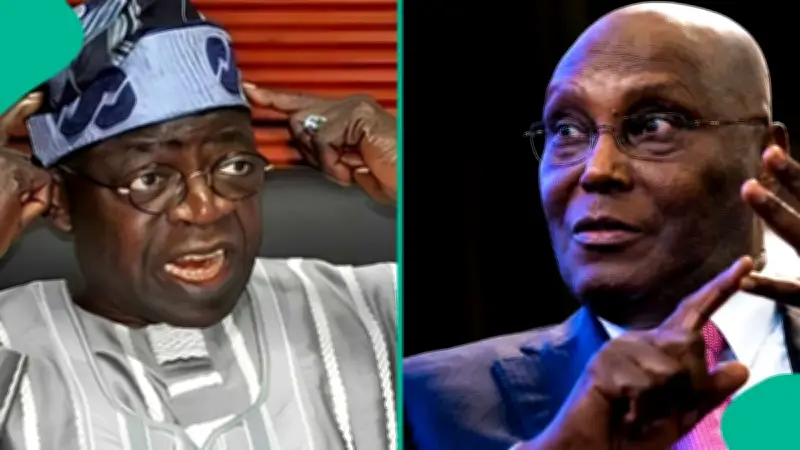
Kenneth Okonkwo, the spokesperson for the Atiku Abubakar presidential campaign council, has announced that Atiku will scrap President Bola Tinubu's floating exchange-rate policy if he wins the 2027 presidential election. Okonkwo made this declaration on Monday, September 14, during an appearance on Democracy Today, a programme on AIT, while criticising the federal government's decision to allow market forces to play a major role in determining the value of the naira.
Okonkwo criticises naira float
Okonkwo argued that it was irresponsible for a government to leave the value of its currency entirely to market forces. "No country in the whole world leaves their currency undefended," he said. The Atiku campaign spokesperson said protecting the value of the naira should be a key component of the country's macroeconomic policy.
"What did you call macroeconomic policy? The whole idea of macroeconomic policy is to defend your currency, because once your currency becomes like dust, nobody is going to desire it," he said. Okonkwo also recalled the period when the naira traded at almost N2,000 to a dollar, questioning why the government waited before intervening to support the currency. "Have you forgotten when the naira was climbing almost to N2,000 per dollar? This government remembered to start defending the naira. Why wait for it to crumble?" he asked.

Atiku's proposed approach
Okonkwo said the strength of the naira was closely linked to Nigeria's ability to increase exports and reduce dependence on imports. "What makes your naira strong? When your export is more than your import, your currency starts gaining power," he said. He also criticised what he described as government policies that encourage imports, citing a reported N34 billion import waiver.
However, when reminded that recent National Bureau of Statistics data showed Nigeria's exports exceeding imports, Okonkwo dismissed the development as insufficient to demonstrate meaningful economic progress. "Not that you made any appreciable increase. It cannot be progress because life is still unaffordable," he said.
Obi takes different position
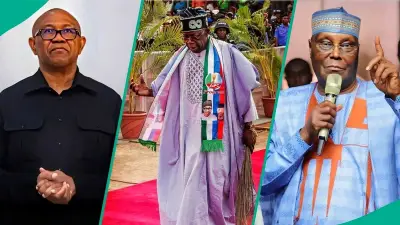
Atiku's position on the naira exchange-rate policy differs from that of Peter Obi, presidential candidate of the Nigeria Democratic Congress (NDC), ahead of the 2027 election. Obi has said he would retain Tinubu's floating exchange-rate policy if elected, arguing that he would focus on increasing productivity rather than defending the naira directly.
The Central Bank of Nigeria introduced the "willing buyer, willing seller" model on June 14, 2023, as part of reforms aimed at unifying the country's multiple foreign exchange market segments. The reform was introduced shortly after Tinubu assumed office and was designed to allow supply and demand to play a greater role in determining the naira's value, while improving transparency and price discovery in the foreign exchange market.
The naira subsequently depreciated sharply following the reform, with the exchange rate at the Investors' and Exporters' window closing at N770.88 per dollar at the end of June 2023, compared with N460 per dollar at the end of December 2022, according to CBN data. With the 2027 elections approaching, opposition politicians have increasingly begun outlining their economic policies and proposed alternatives to the Tinubu administration's reforms.
Atiku accuses presidency
Previously, Legit.ng reported that former Vice President Atiku Abubakar accused the Tinubu administration of wilfully twisting the details of his production subsidy proposal, saying the government used Dangote Refinery's legitimate business concerns as a tool to spread fear rather than engage honestly on policy. The accusation came in a statement sighted by Legit.ng and released on September 11, 2026, by his Senior Special Assistant on Public Communication, Phrank Shaibu.