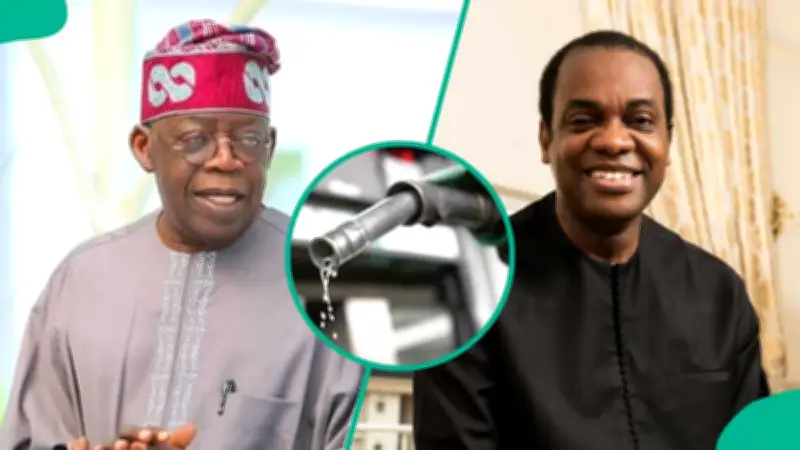
Former Cross River State Governor Donald Duke has advised President Bola Tinubu to reduce petrol prices by pricing domestic crude oil at its actual production cost rather than international market rates. Speaking in Abuja, the former Peoples Redemption Party (PRP) presidential candidate argued that the current fuel subsidy debate overlooks a fundamental point: Nigerian crude belongs to its citizens.
Duke's Proposal: Domestic Crude at Production Cost
Duke noted that Nigeria produces roughly 1.7 million barrels of crude oil daily, but only about 300,000 barrels are needed for domestic consumption. He argued that this domestic portion should be sold to local refineries at the cost of production, not at international prices, which currently hover around $70 or $80 per barrel.
"We produce about 1.7 million barrels. About 1.4 million barrels we sell commercially. These 300,000 barrels, look at the cost of production, not the international price. While we sell oil at $70 or $80 a barrel, the cost of production may not exceed $40 a barrel. That barrel has about seven by-products," Duke stated.

Commercialising By-Products to Lower Prices
The core of Duke's proposal relies on maximizing the value of the multiple by-products derived from a single barrel of crude oil. He pointed out that petrol is just one of several products extracted during refining and should not carry the financial burden of the entire barrel. By selling the other by-products at full commercial rates and adding a modest margin to cover local refining and distribution, he maintains the government can easily lower petrol prices to between N200 and N300 per litre.
"Give it to us at the cost of production, not at the market price. Take into cognisance the cost of refining and distribution and put five or 10 per cent above it. Sell the five other by-products from a barrel of crude at commercial rates. You will find that you can easily amortise the petrol and give it to your people at N200 or N300," he said.
Impact on Fuel Subsidy Debate
Duke maintained that this strategy would deliver affordable energy to drive economic activity and lower fuel costs without returning Nigeria to the previous, unsustainable subsidy regime. His remarks come amid ongoing discussions about fuel pricing and subsidy reforms in the country.