
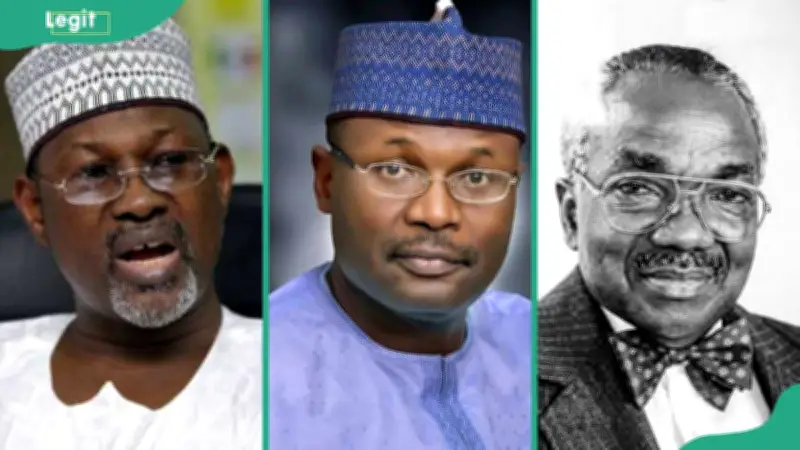
Nigeria has had twelve electoral commission chairmen since its independence in 1960, starting with Eyo Esua. Some oversaw credible elections, while others presided over chaos. A few were removed, some resigned, and one died in office. Their tenures track Nigeria's democratic struggles more honestly than most official histories.
Key Takeaways
- Nigeria has operated under six different electoral bodies since 1960, with twelve men serving as chairman across all of them.
- Humphrey Nwosu conducted Nigeria's freest election in 1993 but watched it annulled by the same government that appointed him.
- Maurice Iwu's 2007 elections produced a record 6,180 court cases and governorship nullifications in seven states.
- Attahiru Jega is the only INEC chairman to have overseen an election in which a sitting president was defeated at the ballot box.
List of INEC Chairmen Since 1960
The Independent National Electoral Commission (INEC) was officially established in 1998. Before then, the country operated under six different electoral bodies, each created, dissolved, or renamed as governments changed hands. The Federal Electoral Commission (FEC) was the first body to oversee elections post-independence. It later gave way to FEDECO, which was also scrapped after the 1983 coup. For four years, from 1983 to 1987, Nigeria had no electoral commission at all.
The Buhari and early Babangida governments saw no need for one. When Babangida eventually created the National Electoral Commission (NEC) in 1987, the transition to democracy was already being managed on military terms. The National Electoral Commission of Nigeria (NECON) followed, then INEC in 1998. Across all these bodies, fourteen men have served as chairmen.
- Mahmood Yakubu (2015–present)
- Attahiru Jega (2010–2015)
- Maurice Iwu (2005–2010)
- Abel Guobadia (2000–2005)
- Ephraim Akpata (1998–2000)
- Sumner Dagogo-Jack (1994–1998)
- Okon Uya (1993)
- Humphrey Nwosu (1989–1993)
- Eme Awa (1987–1989)
- Victor Ovie-Whiskey (1980–1983)
- Michael Ani (1976–1979)
- Eyo Esua (1960–1966)
Eyo Esua: 1960–1966
Eyo Esua was the first chairman of the Electoral Commission of Nigeria (ECN) at independence in 1960. He did not chair INEC, which did not exist yet. He oversaw the machinery of a newly independent nation still learning what elections meant. His most consequential moment came with the 1964 federal elections and the 1965 Western Region elections. Both were catastrophic. The 1964 polls were marred by widespread boycotts, violence, and manipulation. The crisis nearly collapsed the First Republic. The 1965 Western Region elections were worse, with violence erupting across the region in what became known as Operation Wet E. It was the electoral failure of 1965 that provided the immediate political context for the January 1966 coup. Esua operated under a civilian government but with institutions too weak to allow clean elections.
Michael Ani: 1976–1979
Michael Ani was appointed chairman of the Federal Electoral Commission (FEDECO) by the military government of Olusegun Obasanjo. His mandate was to return Nigeria to civilian rule after 13 years of military governance. The 1979 elections were relatively peaceful, but Shehu Shagari's presidential victory was immediately disputed over a constitutional requirement. FEDECO ruled that one-third of 25 percent was sufficient for the 13th state, a decision critics called mathematical gymnastics. The Supreme Court upheld the result. Ani completed his tenure, but his commission left behind a legitimacy question that shadowed the Second Republic.
Victor Ovie-Whiskey: 1980–1983
Victor Ovie-Whiskey inherited a commission already bruised by the legitimacy questions of 1979. He chaired FEDECO through the 1983 general elections, widely regarded as the most fraudulent in Nigerian history up to that point. Results were announced before voting ended in some states. Ballot boxes were stuffed openly. Ovie-Whiskey's FEDECO certified results that defied basic arithmetic. Six months later, on December 31, 1983, the military struck, citing electoral fraud among the justifications for the coup. Ovie-Whiskey was removed.
Eme Awa: 1987–1989
Eme Awa was a political scientist appointed by Ibrahim Babangida in 1987 to head the National Electoral Commission. He came with strong academic credentials and a reputation for integrity. He successfully conducted the 1987 local government elections and the elections to the Constituent Assembly in 1989, but the 1987 elections were poorly managed. Awa served only 19 months before resigning after a disagreement with Babangida, unwilling to compromise his independence.
Humphrey Nwosu: 1989–1993
Humphrey Nwosu arrived at the National Electoral Commission (NEC) with a reputation for independence and an appetite for reform. He introduced the Option A4 voting system, an open queue method that was transparent and hard to manipulate. The June 12, 1993, presidential election was his crowning achievement and his undoing. By all accounts, it was free and fair. Moshood Abiola won convincingly. Then General Ibrahim Babangida annulled it. Nwosu, caught between a military president and a mandate he had certified, resigned. He maintained for the rest of his life that the election was legitimate.
Okon Uya: 1993
Okon Uya was a professor of history appointed by Ibrahim Babangida to replace the dismissed Humphrey Nwosu. His mandate was to organise a fresh presidential election following the June 12 annulment. He never got the chance. The confusion prevented him from conducting the election before Abacha seized power and dismissed him. His tenure lasted five months.
Sumner Dagogo-Jack: 1994–1998
Sumner Dagogo-Jack was appointed by Sani Abacha to chair the renamed National Electoral Commission of Nigeria, NECON. His commission was reportedly not impartial and was controlled by Abacha. The elections he oversaw were not genuine democratic exercises. When Abacha died suddenly in June 1998, the transition programme collapsed. NECON was dissolved. Dagogo-Jack's four years produced no credible election.
Ephraim Akpata: 1998–2000
Ephraim Akpata was a retired Justice of the Supreme Court appointed by General Abdulsalami Abubakar to establish and lead INEC. The task was enormous: Nigeria needed to transition from military rule to democracy within months. Akpata moved decisively, ruling that only parties with broad-based national support would qualify. Of 26 political associations, only three met the threshold. The 1998–1999 elections were conducted in stages, culminating in the presidential election that brought Olusegun Obasanjo to power. Akpata died in office on January 8, 2000.
Abel Guobadia: 2000–2005
Abel Guobadia was an educator and former diplomat appointed by President Olusegun Obasanjo to succeed the late Ephraim Akpata. His defining moment came with the 2003 general elections, the first civilian-to-civilian transfer of power in Nigeria's history. European Union observers reported serious irregularities and fraud. Opposition parties rejected the results. Guobadia rejected the vote rigging claims and defended the election's integrity. He retired in May 2005, becoming the first INEC chairman to complete a full tenure.
Maurice Iwu: 2005–2010
Maurice Iwu was a professor of pharmacognosy with no electoral management experience when President Olusegun Obasanjo appointed him INEC chairman in June 2005. The 2007 elections were Nigeria's lowest point in the democratic era. The EU observer mission reported that the polls fell far short of basic international standards. A record 6,180 cases were brought before the courts, and governorship results were nullified in seven states. Iwu declared the elections free and fair. Acting President Goodluck Jonathan removed him in April 2010. The EFCC later charged him with money laundering.
Attahiru Jega: 2010–2015
Attahiru Jega arrived at INEC carrying one of the heaviest mandates in its history. He inherited an institution widely perceived as fraudulent and corrupt. He introduced biometric voter registration, Permanent Voter Cards, and smart card readers. The 2011 elections were assessed as significantly more transparent than preceding cycles. The 2015 elections went further: for the first time, an opposition candidate defeated a sitting president at the ballot box. Muhammadu Buhari defeated Goodluck Jonathan, who conceded by phone. Jega completed his tenure, only the second INEC chairman to do so.
Mahmood Yakubu: 2015 to Present
Mahmood Yakubu was appointed by President Muhammadu Buhari on October 21, 2015, becoming the first INEC chairman from Nigeria's North-East geopolitical zone. He holds a doctorate in history from Oxford University and had no prior electoral management experience. His first major test came with the 2019 polls. His tenure has focused on institutional consolidation, voter registration drives, and preparing the commission for fiercely contested elections.
Who Are the INEC Chairmen from 1999 to Date?
The list of INEC chairmen from 1999 to 2026 includes five men: Ephraim Akpata (1998–2000), Abel Guobadia (2000–2005), Maurice Iwu (2005–2010), Attahiru Jega (2010–2015), and Mahmood Yakubu (2015–present).
Who Is the First INEC Chairman in Nigeria?
Justice Ephraim Akpata was the first INEC chairman in Nigeria, appointed in 1998 by General Abdulsalami Abubakar to lead the newly established Independent National Electoral Commission. He oversaw the 1999 elections that returned Nigeria to civilian rule after 15 years of military governance.
From Eyo Esua to Mahmood Yakubu, the story of past INEC chairmen in Nigeria is ultimately a story about institutions under pressure. Some men bent. Some broke. A few held firm. The elections they conducted shaped governments, triggered coups, and occasionally, as in 2015, surprised the world. The chair of INEC has never been a comfortable seat.




