
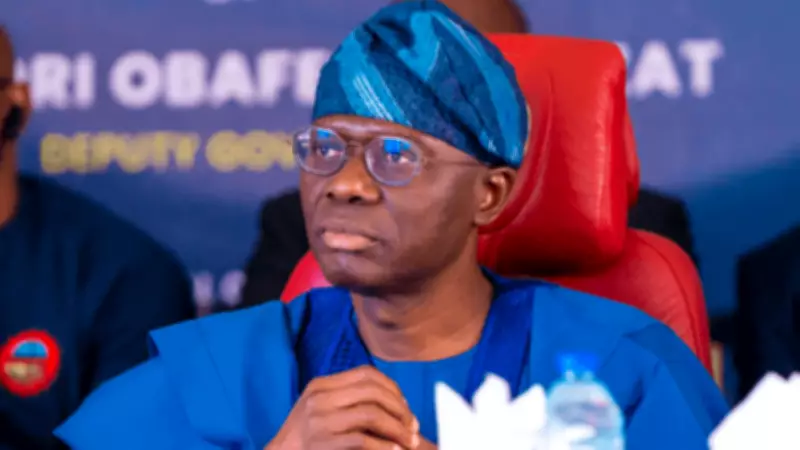
Lagos State Governor Babajide Sanwo-Olu celebrated workers during this year's Workers' Day festivities, assuring them that discussions on further minimum wage adjustments in Lagos remain ongoing and that engagement with organized labour continues. He emphasized that his administration views workers not as budget lines or voting blocs, but as the living infrastructure of Africa's most consequential city.
The event, held at Mobolaji Johnson Arena in Onikan, Lagos, drew a smaller crowd than in previous years, but the governor's pledge of enhanced wages delighted attendees. The 2026 theme, 'Insecurity, Poverty: Bane of Decent Work,' aimed to honestly assess conditions hindering Nigerian workers from achieving genuine dignity.
Sanwo-Olu, represented by Deputy Governor Dr. Obafemi Hamzat, acknowledged that dialogue with the Nigerian Labour Congress (NLC) and Trade Union Congress (TUC) has not always been smooth, but insisted that a government must withstand scrutiny from organized labour. 'Let me speak to the theme of insecurity plainly. The safety of workers on the street, on the bus, at the market, and in the office is not a peripheral concern. It is foundational. A city where people do not feel safe cannot be a city where people work productively. Our investments in security infrastructure, community policing, expansion of our surveillance network, and ongoing partnerships with federal security agencies are not separate from our labour agenda; they are part of it.'
He added, 'Lagos is not great because of its government. Lagos is great because of the teacher who stays after hours, the nurse who takes a third shift, the artisan who passes their trade to the next generation, and the civil servant who processes the thousandth form with the same care as the first. Our job, my job has always been to make sure that the city you are building is also a city that works for you. We have not finished that work, but we are closer than ever, and we will not stop.'
Meanwhile, the Committee of Gig Workers' Unions of Nigeria (COGWUJ) demanded proper recognition and improved welfare. COGWUJ is a coalition of 13 gig workers' unions, including the Nigerian Union of Good Delivery App Transporters (NUFDAPPT), the Nigerian Union of Digital Personal Service Employees (NUDPSE), and the Nigerian Union of App-Based Home Services Employees (NUAPHSE), among others. 'As we celebrate this year's May Day, the fate of gig workers is nothing to write home about. We need proper recognition as workers under Nigerian labour law and by our big-tech employers. We need the right to social protection and pensions. Are you interested in this noble struggle?'
The Socialist Equality Party (SEP), in political solidarity with the International Committee of the Fourth International (ICFI), extended solidarity with workers and youth in Nigeria and globally, stating that working people in Nigeria now stand at an important crossroads in history. 'In less than eight months' time, working-class people will be queuing up for elections in which they have no party of their own and will be left to choose between their oppressors. In 2023, the misnamed Labour Party, largely run by right-wing party bureaucrats as a money-making commercial vehicle for defectors from dominant pro-rich parties such as the People's Democratic Party and the All Progressives Congress, presented Peter Obi as its presidential candidate, alongside other right-wing members of the House of Representatives and Senate. However, between June 10, 2023, and now, many of these members have defected to either the All Progressives Congress or the People's Democratic Party. Obi himself, despite the widespread support he enjoyed from trade union bureaucrats and sections of the working class and youth, has since moved to the ADC.'
The SEP continued, 'The truth is that the APC, ADC, PDP, and similar parties are essentially the same. Unfortunately, the Labour Party does not have a fundamentally different character or programme either. Working people need a party of their own, founded on a programme of socialism and equality. The formation of the Socialist Equality Party is principled, not conjectural, emotional, or pragmatic. It is based on an analysis of the crisis in Nigeria and Africa within the broader crisis of world capitalism, and on the strategic experiences of the working class and the international socialist movement. We are building an international mass movement of workers and youth to challenge global capitalism. It is on this basis that we are in political solidarity with the ICFI, an international socialist organisation grounded in the ideas of Karl Marx, Friedrich Engels, Vladimir Lenin, and Leon Trotsky.'




