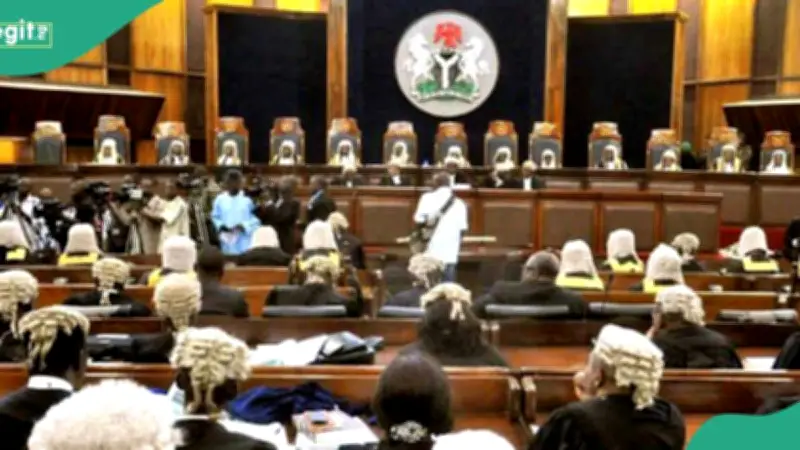
The Supreme Court of Nigeria has reserved judgment in an appeal filed by the Independent National Electoral Commission (INEC) against a Court of Appeal decision that nullified certain provisions of the Electoral Act 2026. The case, marked SC/CR/495/2026, was heard on Wednesday by a seven-member panel presided over by Justice Adamu Jauro.
The dispute centres on provisions of the Electoral Act concerning political party primaries and membership registers. The Zenith Labour Party (ZLP) had argued that these provisions conflict with the 1999 Constitution. After hearing submissions from both INEC and the ZLP, Justice Jauro announced that the court would not deliver its ruling immediately.
Justice Jauro's Statement on Reserved Judgment
Justice Adamu Jauro told the parties: "This matter is now reserved for judgment, at a date to be communicated to the parties." The Supreme Court did not specify when the judgment would be delivered, stating only that the parties would be informed of the date in due course.

The case originated from a suit filed by the ZLP at the Federal High Court in Abuja, tagged FHC/ABJ/509/2026, challenging the contested Electoral Act provisions. Justice Mohammed Umar of the Federal High Court dismissed the ZLP's claim in a ruling delivered on May 5, 2026.
Appeal Process and Court of Appeal Ruling
Unsatisfied with the Federal High Court's decision, the ZLP appealed to the Court of Appeal, which ruled in the party's favour by voiding the disputed provisions. That decision prompted INEC, listed as the appellant in the Supreme Court proceedings, to escalate the matter to the country's highest court, with the ZLP named as the respondent.
The case carries significance for how political parties conduct internal elections and maintain membership records under Nigerian electoral law. The Supreme Court's eventual judgment will determine whether the contested provisions of the Electoral Act 2026 remain in force or are struck down, affecting party primaries and membership register requirements across the country.
As the apex court reserves its decision, political parties and electoral stakeholders await the communicated date for judgment, which will provide clarity on the legal framework governing party internal democracy in Nigeria.