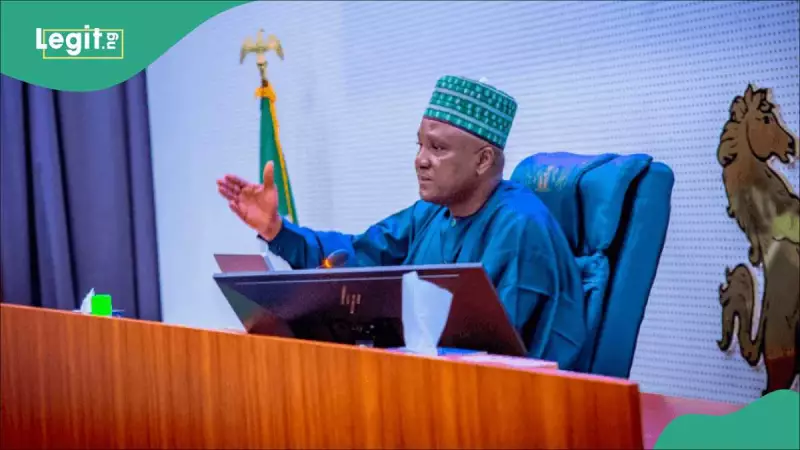
The Speaker of Nigeria's House of Representatives, Rt. Hon. Abbas Tajudeen, has been credited with successfully steering the Green Chamber through a turbulent 2025, emerging with his leadership credentials significantly bolstered. According to a key lawmaker, the year presented a series of intense political and institutional challenges that tested the very fabric of the assembly.
A Defining Year for the 10th Assembly
In an exclusive interview on Wednesday, December 31, 2025, the Deputy Spokesperson of the House, Rep. Philip Agbese, reflected on the trials of the past year. He described 2025 as a defining period for the 10th House of Representatives, one filled with pressures from both within and outside the legislature.
Agbese insisted that throughout these trials, Speaker Abbas stood as an unwavering pillar of truth, sacrifice, and stability. He emphasized that the House remains firmly committed to its role in strengthening Nigeria's democratic institutions, a commitment that was put to the ultimate test.
"Despite the many challenges we encountered in 2025, Speaker Abbas justified his leadership," Agbese stated. "He proved that leadership is not about convenience, but about standing on truth and making sacrifices for the collective good of the institution and the country."
Crisis Management and Institutional Preservation
The lawmaker highlighted specific incidents that could have fractured the House's unity under less adept leadership. He pointed to the raging controversy over alleged alterations to gazetted tax laws as a prime example. According to Agbese, such an issue in previous assemblies might have led to severe discord.
However, Speaker Abbas's approach averted disaster. His response was characterized by a high level of restraint, extensive consultation, and strict adherence to parliamentary rules. "There were issues in 2025 that, if it were to be in the past, would have broken the unity of the House," Agbese explained. "But under Speaker Abbas, those issues did not escalate because he placed the institution above personal or sectional interests."
To address the tax law controversy, Abbas swiftly constituted a 7-man ad-hoc committee to investigate the matter. Furthermore, in a joint move with Senate President Godswill Akpabio, he directed the Clerk to the National Assembly to commence the process of re-gazetting the tax laws. This action ensured the laws aligned with the version approved by the National Assembly, a step Agbese hailed as a demonstration of responsive and responsible leadership.
Navigating the NASC Recruitment Quagmire
Another critical test came with the controversy surrounding recruitment into the National Assembly Service Commission (NASC). Agbese recalled this as an exceptionally delicate moment where emotions ran high and conflicting interests created intense pressure.
"The NASC employment controversy almost turned the parliament against itself," he admitted. "Emotions were high, interests were conflicting, and pressure was intense. But the Speaker handled it with wisdom and maturity, ensuring that the House did not descend into chaos."
Agbese clarified that staff recruitment is handled by an independent body, not the House leadership, a fact he said was often misunderstood. He used the opportunity to dismiss any reports of a looming face-off with Speaker Abbas, asserting that members remain solidly and unwaveringly behind his leadership.
A Model of Principled Leadership
Reflecting on the Speaker's character, Agbese praised Abbas as a principled leader who "believes white is white and black is black" and who commands the full trust of his colleagues. He previously grouped Speaker Abbas with other lawmakers like Dr. Patrick Umoh and Hon. Boma Goodhead as rare models of integrity in the National Assembly.
These individuals, Agbese noted, embody honesty and transparency, offering reassurance that credible leadership is still attainable within the legislature. The events of 2025, as narrated by the Deputy Spokesperson, ultimately served to reinforce Abbas's position and demonstrate a leadership style focused on institutional preservation and national interest over political expediency.