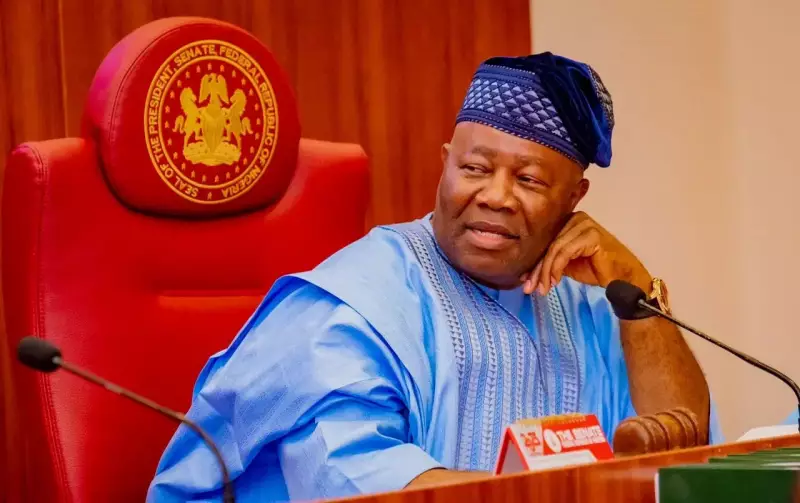
Senate President Godswill Akpabio has issued a strong appeal for increased police protection for members of the National Assembly. He made this call during a crucial joint session of the Senate and the House of Representatives on Friday, 19 December 2025, just before President Bola Ahmed Tinubu presented the government's budget estimates.
Lawmakers Share Citizens' Pain and Vulnerability
Speaking against a backdrop of severe economic strain and widespread insecurity, Akpabio emphasized that legislators are not isolated from the nation's struggles. He stated that lawmakers constantly carry the grief and anxieties of their constituents into the hallowed chambers.
"Too many Nigerians continue to struggle with the cost of living. Too many communities remain burdened by insecurity," Akpabio declared. He stressed that the tragedies affecting the nation are not mere statistics but represent real human lives lost and families broken.
The Senate President argued that while the government's primary duty is to protect lives and property, those making the laws must also be secure. He highlighted that legislators, being at the forefront of public engagement, require adequate protection to perform their constitutional roles effectively without fear.
A Veiled Response to Police Withdrawals
Akpabio's remarks are seen as a direct response to growing concerns within the National Assembly over the recent withdrawal of police personnel attached to lawmakers. This policy is part of a broader initiative to redeploy officers to frontline policing duties across the country.
Although he did not explicitly mention the withdrawal order, his emphasis on legislative security was widely interpreted as a plea to the executive branch to reconsider such measures. Analysts note that rising inflation and public frustration have sometimes boiled over into hostility directed at elected officials, with several lawmakers facing threats and protests in their constituencies recently.
"Insecurity is not selective," Akpabio warned. "It tests our collective resolve and reminds us that peace is not inherited—it must be constantly defended." He pointed out that the dangers plaguing ordinary citizens inevitably extend to their representatives.
A Broader Call for Institutional Harmony
Akpabio anchored his security appeal within a larger framework of institutional cooperation. He argued that national progress is impossible without harmony between the Executive and the Legislature, drawing lessons from the political histories of the United States and the United Kingdom.
He cautioned that conflicts between the two arms of government, especially over budgetary and security matters, could weaken state institutions and erode public trust. This scenario, he noted, has played out in other nations experiencing prolonged political deadlock.
Despite the pressures, Akpabio praised the productivity of the 10th National Assembly, which has passed significant legislation on:
- Security sector reform
- Fiscal policy and governance
- Judicial administration
- Social protection programs
These reforms, according to him, aim to strengthen Nigeria's security architecture, improve intelligence coordination, and rebuild public confidence in government. However, he cautioned that such legislative effectiveness cannot be sustained if the lawmakers themselves feel unsafe in their duties.
"The task of nation-building requires patience, sacrifice, and unity of purpose," Akpabio concluded. "But those entrusted with this responsibility must also be protected."
Balancing Governance Realities with Public Sentiment
The call for enhanced police protection comes at a sensitive time when public debate is intensifying over the privileges of political officeholders amidst widespread national hardship. Akpabio acknowledged this public suffering and rejected any notion that lawmakers are insulated from the national pain.
He insisted that the legislature remains committed to ensuring that every naira in the budget delivers tangible value to Nigerians. Acknowledging the difficulty of the path ahead, Akpabio stated, "The path of reform is not easy. But it is the only path that leads forward."
With President Tinubu presenting the budget immediately after this address, expectations are high that security funding—for both citizens and those governing them—will be a major point of discussion. Observers view Akpabio's speech as an attempt to balance public sensitivity with the practical necessities of governance, as Nigeria grapples with twin challenges of economic strain and security threats.
Whether the executive will respond to these concerns on police protection remains to be seen. Nevertheless, Akpabio's intervention has firmly placed the issue of lawmakers' security within the broader national conversation on Nigeria's democratic stability amidst hardship.