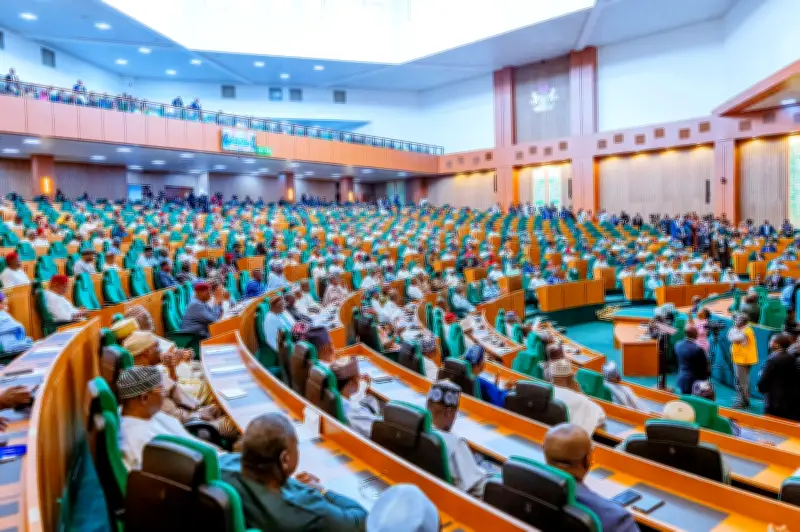
The House of Representatives concluded a busy legislative week by passing the Constitution Alteration (State Police) Bill, 2026, which aims to create a constitutional framework for state police services across Nigeria. The passage, however, was marred by a dramatic walkout by the minority caucus, who protested the procedure used. Lawmakers also considered several other bills and motions before embarking on a long recess.
State Police Bill Passes with Controversy
The bill was passed after the House considered and adopted the report of the Committee on Constitution Review, chaired by Deputy Speaker Benjamin Kalu. Speaker Abbas Tajudeen, presiding over the Committee of the Whole, detailed the voting process: 211 members from the All Progressives Congress (APC) were physically present, along with 65 from other parties, while 35 participated virtually. In total, 311 members either signed the attendance register or joined online, surpassing the constitutional requirement of two-thirds of the 360-member House (240 members). The bill contains 26 clauses, an explanatory memorandum, and the long title.
Kalu noted that the amendment would not resolve all concerns but would provide the legal foundation for subsequent detailed implementation legislation. Despite the numerical success, the minority caucus objected to the procedure, staging a walkout immediately after the vote.
Minority Caucus Protests Procedure
Minority Leader Fred Agbedi (PDP, Bayelsa) told journalists that the caucus supports state police but rejected what they called a disregard for the Constitution and House Standing Orders. He cited Order 13.15(a), which requires clause-by-clause consideration and a two-thirds vote on each clause. Agbedi argued that the adopted procedure denied lawmakers the chance to vote individually or propose amendments. He added that the caucus had earlier informed the speaker of desired amendments, acknowledging that Tajudeen recognized some concerns but proceeded anyway.
Unfortified Edible Oil Bill Stepped Down
Another major item was the bill to prohibit unbranded and unfortified edible oil, sponsored by Chike Okafor (APC, Imo). During second reading, Okafor highlighted health risks, noting that 67% of Nigerians consume unbranded oil and only 31% of edible oil in circulation is fortified. However, lawmakers opposed the blanket ban, arguing it could harm rural producers and duplicate the work of agencies like NAFDAC. Okafor clarified the bill aimed to reinforce existing regulations, not undermine them. The House stepped down the bill for further consultations and harmonization with existing laws.
Investigation into Xenophobic Attacks in South Africa
The House adopted a motion by Babajimi Benson (APC, Lagos) to investigate human and economic losses from repeated xenophobic attacks in South Africa. Benson noted that despite diplomatic protests, Nigeria has not conducted a comprehensive assessment of casualties and damage over nearly two decades. Supporting the motion, Paschal Agbodike (APC, Anambra) urged compensation for repatriated Nigerians who lost businesses. The Committees on Diaspora and Foreign Affairs will probe casualties and losses from past and recent attacks.
Fake Agency Probe Continues
The ad hoc committee investigating the Presidential Foreign Investment Promotion Council (PFIPC), chaired by Yusuf Gagdi, continued its probe. The Central Bank of Nigeria (CBN) told the committee that two foreign currency accounts (USD and GBP) opened for the PFIPC in July 2025 were never activated. A CBN official stated the bank opened the accounts after a mandate from the Office of the Accountant-General of the Federation (OAGF), but the PFIPC failed to complete documentation, including authorized signatories and signature mandate cards. The committee will further examine the council's legality and operations.