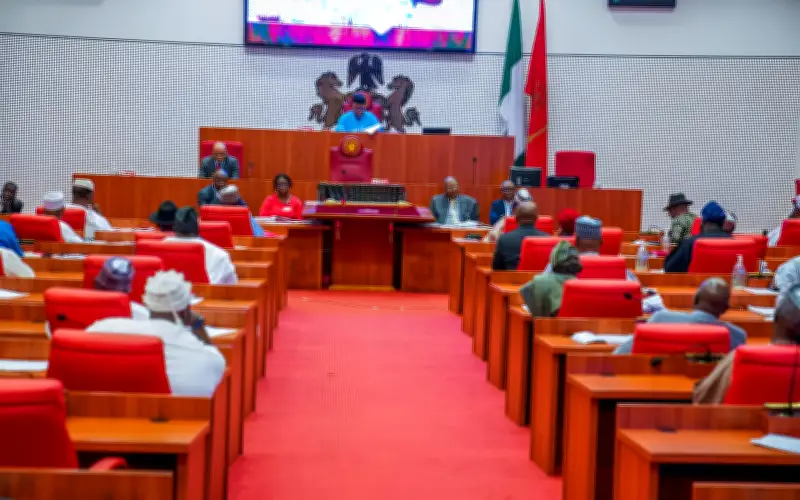
The Nigerian Senate on Thursday adjourned plenary for its annual recess, with lawmakers scheduled to resume on 15 September. Before the break, the upper chamber debated and passed several bills and motions, adopting a number of resolutions. Below are the major legislative actions taken during the final sitting days.
Bill to Rename NAICOM Passed
On Tuesday, the Senate debated and passed a bill seeking to rename the National Insurance Commission (NAICOM) as the Insurance Regulatory Commission. The bill, sponsored by Senator Adetokunbo Abiru, along with other members of the Senate Committee on Banking, Insurance and Other Financial Institutions, was approved after consideration of the committee’s report. Presenting the report, Senator Abiru explained that the current name had become confusing due to the evolution of Nigeria’s insurance industry and no longer accurately reflected the commission’s regulatory mandate.
The bill introduces tougher enforcement measures, including higher fines, licence suspensions, and disqualification of individuals responsible for the failure of insurance institutions from holding positions in the industry. It also updates provisions on supervision, inspection, and intervention to address current challenges, such as the need for ministerial approval to remove or appoint directors of failing or distressed insurance institutions. Additionally, the legislation requires the Minister of Finance to constitute an interim management committee for the commission within 30 days of the expiration or termination of the tenure of its governing board. The new law expands the commission’s mandate to ensure effective administration, supervision, regulation, control, integrity, and development of insurance business in Nigeria.
Extension of Safe Schools Programme Probe
The Senate extended by two weeks the deadline for its ad hoc committee investigating the spending of more than $30 million on Nigeria’s Safe Schools Programme, a federal security initiative launched in 2014. The upper chamber also broadened the committee’s mandate to include an investigation into education-related funds managed by the Tertiary Education Trust Fund (TETFund), the Nigerian Education Loan Fund (NELFUND), and the Universal Basic Education Commission (UBEC). Furthermore, the committee will examine how education support funds administered by the Federal Ministry of Humanitarian Affairs and Poverty Alleviation and the National Social Investment Programme Agency (NSIPA) were utilised. The resolution was adopted after a motion by committee chairman Senator Orji Kalu, who sought an expansion of the panel’s terms of reference and additional time to conclude its investigation.
AMCON Directed to Prepare Wind-Down Report
The Senate Committee on Banking, Insurance and Other Financial Institutions directed the Asset Management Corporation of Nigeria (AMCON) to prepare a comprehensive report on its operations ahead of the corporation’s planned wind-down in 2030. Committee chairman Adetokunbo Abiru gave the directive during the screening of Lamido Yuguda, a deputy governor of the Central Bank of Nigeria (CBN), for confirmation as chairman of AMCON’s board. The call for a comprehensive report was first raised by Senator Sani Musa (Niger East), who urged Mr Yuguda, if confirmed, to begin compiling a detailed account of AMCON’s activities, achievements, and unresolved obligations before the corporation’s expiration.
Senate Honors Late Former Senator Anthony Adeniyi
The Senate on Wednesday sympathised with the family of former Senator Anthony Adeniyi, who represented Ekiti South Senatorial District between 2011 and 2015. Mr Adeniyi, a Senior Advocate of Nigeria (SAN), died on 24 June at the age of 75. Until his death, he served as the Ekiti State chairman of the South West Agenda for Asiwaju (SWAGA), the political movement that mobilised support for President Bola Tinubu ahead of the 2023 general election. The Senate considered a motion on his death, moved by Senator Yemi Adaramodu (Ekiti South), during Wednesday’s plenary.
Senate Frowns at MDAs’ Disregard for Resolutions
The Senate on Wednesday adopted a report by its Committee on Legislative Compliance detailing the implementation of resolutions arising from motions passed between July 2023 and December 2025. The report, presented by committee chairman Senator Garba Maidoki, assessed the impact of Senate resolutions and the level of compliance by ministries, departments, and agencies (MDAs), particularly on road rehabilitation, disaster management, and other matters affecting Nigerians. Senator Maidoki (Kebbi South) said the committee tracked implementation and found many resolutions were delayed or ignored. He noted that despite the committee’s efforts, many MDAs repeatedly failed to respond, describing this as a disregard for the authority of both the committee and the Senate.
Setback for Nigerian Coast Guard Bill
The Senate on Wednesday suspended consideration of the Nigerian Coast Guard Bill due to concerns that the proposed agency’s functions could overlap with those of the Nigerian Navy and the Marine Police. Senate President Godswill Akpabio announced the withdrawal after a voice vote during plenary. The bill, sponsored by Senator Wasiu Eshinlokun (APC, Lagos East), sought to establish the Nigerian Coast Guard to strengthen maritime security, combat illegal fishing, and curb unauthorised activities along Nigeria’s coastline. Mr Akpabio said several senators had privately raised concerns that the proposed Coast Guard would duplicate responsibilities of existing agencies, which are already underfunded, leading to coordination challenges. He added that establishing another maritime security outfit without clearly defining its responsibilities could create unnecessary confusion.
Bill to Compel NGOs to Disclose Foreign Donors Passes Second Reading
A bill seeking to compel non-governmental organisations (NGOs) operating in Nigeria to register all foreign aid and donor-funded projects with the government passed second reading in the Senate on Wednesday. The bill was referred to the Senate Committees on National Planning and Economic Development and Finance for a public hearing, with a directive to report back within four weeks. Sponsored by Senator Ibrahim Dankwambo (Gombe North), the bill seeks to establish a National Donor Coordination Framework, make registration of all donor-funded projects compulsory, and create a national database of foreign assistance. It also proposes integrating donor-funded interventions into government budgets, mandating public disclosure of funding sources and project implementation details, and imposing sanctions for the diversion, misuse, or non-registration of donor funds.
Senate Threatens MDAs Over Disregard for Summons
The Senate on Thursday directed the Secretary to the Government of the Federation (SGF), George Akume, and the Head of the Civil Service of the Federation (HoS), Esther Walson-Jack, to ensure that MDAs that have refused to appear before National Assembly committees honour lawmakers’ invitations. The upper chamber warned that it would not hesitate to impose appropriate sanctions on agencies that continue to disregard committee invitations. The resolution followed a motion by Senator Sani Musa, who complained that heads of several agencies had consistently ignored invitations from the Senate Committee on Finance, which he chairs. The committee recently commenced an investigation into the management of internally generated revenue and remittances by government agencies between 2023 and 2025. Senator Musa said some agencies failed to appear despite repeated invitations.
Concerns Over Bill Compelling Social Media Platforms to Establish Physical Offices
The Nigerian Bar Association (NBA) and the Nigeria Internet Registration Association (NIRA) advised that a bill seeking to compel social media platforms and bloggers operating in Nigeria to establish physical offices with verifiable addresses should be withdrawn. The organisations voiced their concerns during a public hearing organised by the Senate Committee on ICT and Cyber Security on Thursday. The bill, sponsored by Senator Ned Nwoko (Delta North), passed second reading in March 2025 before being referred to the committee. While some stakeholders argued that requiring physical offices could lead to the withdrawal or shutdown of some platforms, others supported the proposal, saying it would create employment opportunities, promote technology transfer, and strengthen corporate social responsibility. Opponents also argued that the 30-day compliance period prescribed in the proposed legislation is too short and should be extended.