
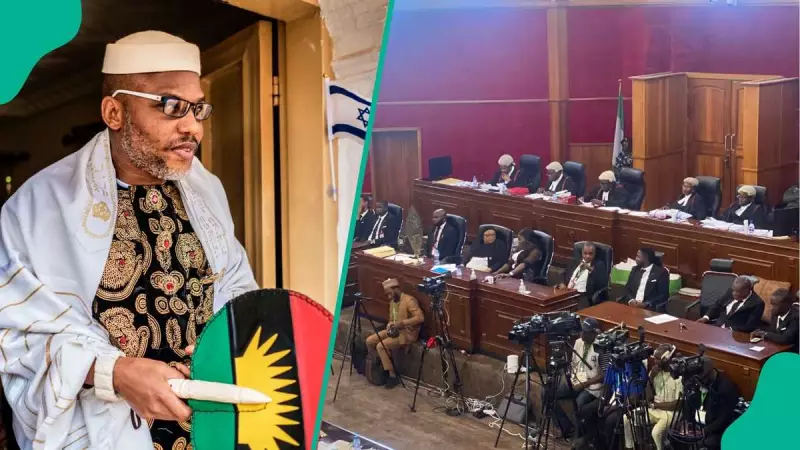
Nnamdi Kanu's Multiple Sentences Trigger National Debate
The sentencing of Nnamdi Kanu, the embattled leader of the proscribed Indigenous People of Biafra (IPOB), has continued to generate diverse reactions across Nigeria. The Federal High Court in Abuja recently handed down multiple prison sentences to Kanu, including life imprisonment on Counts 1, 4, 5 and 6, all tied to terrorism-related offences.
Court Details Strict Conditions for IPOB Leader
According to the judgment delivered on Thursday, November 20, the court also imposed additional sentences of 20 years' imprisonment on Count 3 and 5 years' imprisonment on Count 7, both without the option of a fine. The ruling included particularly strict conditions regarding Kanu's access to digital services during his incarceration.
The court specified that Nnamdi Kanu will be denied any access to digital services, including phones, laptops, and tablets. The judgment noted that any access to these devices would be solely at the discretion of the National Security Adviser (NSA), placing significant control over Kanu's communication capabilities during his imprisonment.
Expert Calls for Dialogue Beyond Legal Measures
Reacting to the development, Olajumoke Shaqiru Victor, a political commentator, emphasized that solving the insecurity challenges in Nigeria's southeast region requires approaches beyond legal measures. In an exclusive interview with Legit.ng, Victor described the case as particularly sensitive and requiring careful handling.
Victor maintained that the issues in the region raise fundamental questions about fairness, inclusiveness, and the management of separatist agitation in Nigeria. He argued that while the legal judgment represents the government's attempt to enforce law and order, lasting peace will require additional measures.
"The sentencing of Nnamdi Kanu remains a sensitive and polarising issue," Victor stated. "For some Nigerians, the judgment represents the government's attempt to enforce law and order and prevent activities that can threaten national unity. For others, the decision raises questions about fairness, political inclusion, and the best way to handle separatist agitations."
Historical Context of Separatist Movements in Nigeria
The current situation reflects Nigeria's long-standing challenges with separatist movements. As a multi-ethnic and multi-religious country, Nigeria has experienced various agitations for secession throughout its history. Soon after independence, similar tensions were the primary factor that led to the country's civil war, which lasted for two and a half years and resulted in significant casualties, including many women and children.
In contemporary Nigeria, the agitation for separation has been led by various individuals, several of whom have faced legal consequences similar to Kanu's situation. Victor emphasized that understanding this historical context is crucial for developing effective solutions to the current challenges.
The Path Forward: Justice Combined with Dialogue
Victor concluded that a comprehensive approach is necessary to address the underlying grievances in the Southeast region. "What is clear is that a legal verdict alone cannot solve the deeper grievances in the Southeast," he explained. "Lasting peace will require both justice and meaningful dialogue, so that security measures are matched with political solutions."
The analyst's comments highlight the ongoing national conversation about how to balance legal enforcement with political engagement in addressing complex security challenges. As reactions to Kanu's sentencing continue to evolve, the call for dialogue suggests that many believe the path to sustainable peace in the Southeast requires addressing both immediate security concerns and long-standing political grievances.




