
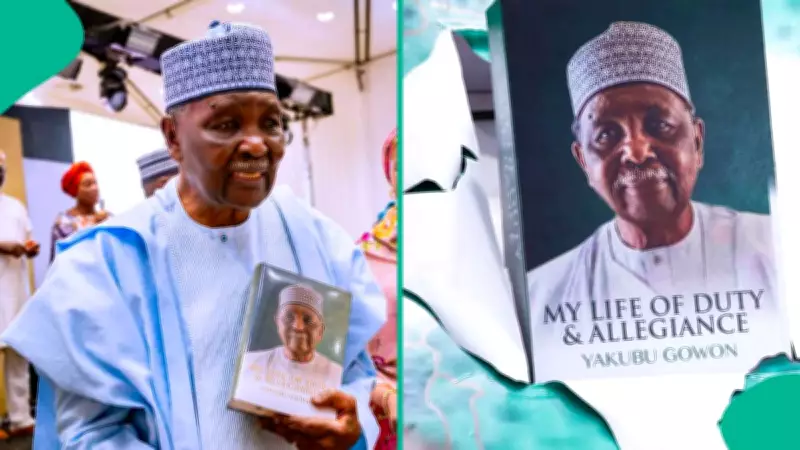
Former Nigerian military Head of State, Yakubu Gowon, has firmly rejected assertions that the Aburi meeting in Ghana sanctioned the secession of the Eastern Region to form Biafra. In his newly released autobiography, Gowon clarifies that the talks were intended to preserve national unity, not to divide the country.
Gowon's Clarification on Aburi Accord
According to Premium Times, the Aburi peace talks, held on January 4 and 5, 1967, were convened to address rising tensions in Nigeria. Gowon's autobiography, My Life of Duty and Allegiance, launched in Abuja, explains that the meeting aimed to safeguard Nigeria's unity. He expressed shock when Chukwuemeka Odumegwu Ojukwu broadcast to the Eastern Region that both sides had agreed to partition Nigeria, calling this a misrepresentation of the resolutions.
Gowon stated: "Politically, it was unanimously agreed that it was in the interest of the safety of this nation that the regions should move slightly further apart than before." He insisted this interpretation was false and inconsistent with the actual agreements.
Nigeria's Political Context Before the War
At independence in 1960, Nigeria comprised four regions: the Northern Region (Hausa-Fulani dominated), Eastern Region (Igbo dominated), Western Region (Yoruba dominated), and Midwest Region (created in 1963 for minority groups). Under Ojukwu, the Eastern Region declared independence as the Republic of Biafra, sparking a civil war from July 6, 1967, to January 15, 1970. The conflict claimed between one and three million lives, many due to starvation and disease.
Gowon's Defense of Nigerian Unity
Gowon argued that the Aburi resolutions renounced force and aimed to maintain unity. He accused Ojukwu of pursuing a personal political agenda: "What Ojukwu said, therefore, merely conformed to his own personal agenda, not the agreed position at Aburi and not what the generality of Nigerians wanted." He noted that the Unification Decree No. 34 of 1966, introduced by General Johnson Aguiyi-Ironsi, had created fears of domination, particularly in the North and West. Upon assuming power, Gowon restored the federal system by abrogating the decree.
Legacy of the Civil War
The Nigerian civil war remains one of Africa's most devastating conflicts. Ojukwu died in London on November 26, 2011, and was buried in Nnewi in March 2012. The debates around Aburi and the war's causes continue to shape Nigeria's political memory. Gowon's memoir reinforces his position that the Aburi meeting was about safeguarding Nigeria's unity, not endorsing secession.
In a related disclosure, Gowon also revealed that former President Olusegun Obasanjo once resisted an order to serve under the late Murtala Muhammed during the civil war, insisting he would not work under a junior officer. This is detailed in Gowon's autobiography, which recounts tense moments from the war's early stages and his long relationship with Obasanjo.




