
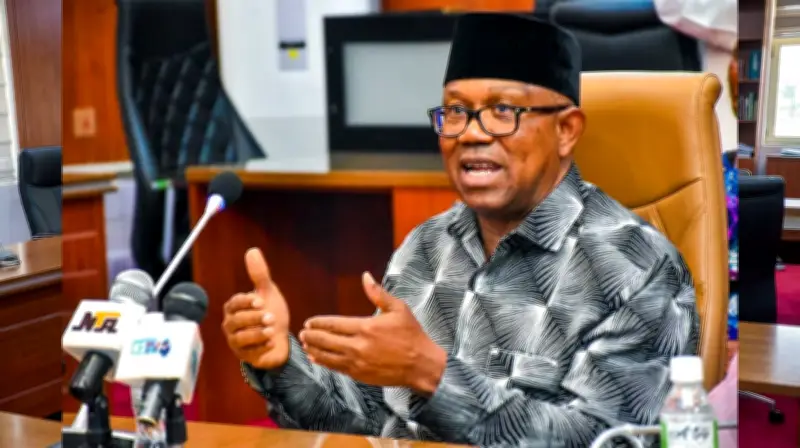
Former presidential candidate Peter Obi has questioned the contradiction between the Federal Government's reported revenue surge and the worsening economic conditions facing millions of Nigerians. He demanded greater transparency over the management of public finances.
In a statement reacting to President Bola Tinubu's assessment of his administration's three years in office, Obi argued that the government's claims of significantly improved revenue generation have not translated into tangible improvements in citizens' lives. The former Anambra State governor noted that President Tinubu highlighted an increase in government revenue from N16.8 trillion in 2022 to N35 trillion in 2025, representing more than a 100% increase within three years.
According to Obi, such a dramatic rise in revenue should ordinarily have reduced the government's dependence on borrowing. Instead, Nigeria's debt profile has expanded at an alarming rate. “While Nigerians expected a reduction in borrowing with the exponential increase in revenue, the opposite appears to be the case,” Obi stated. “In just three years, the nation's total debt has risen to about N200 trillion, representing an increase of over N100 trillion.”
The former presidential candidate further argued that beyond the officially reported revenue growth, Nigeria had also benefited from favourable global and regional economic developments that boosted earnings above budget projections. He maintained that despite these financial inflows, the country's key socio-economic indicators have continued to deteriorate, raising concerns about the effectiveness of government spending and economic management.
Obi cited rising poverty levels, worsening unemployment and declining living standards as evidence that increased government earnings have failed to deliver meaningful benefits to ordinary Nigerians. According to him, multidimensional poverty has increased sharply from about 87 million people in 2023 to over 140 million in 2025, while economic opportunities have continued to shrink for many households struggling with inflation and declining purchasing power.
He also pointed to a fall in Nigeria's Gross Domestic Product (GDP) per capita, which dropped from $1,597 in 2023 to $1,223 in 2025, reflecting the growing strain on citizens despite the government's claims of economic reforms and fiscal gains. The former governor said the disconnect between rising revenues and worsening living conditions has fueled growing public concern over the management of national resources.
“The question Nigerians and even the international community are asking is: Where did all the money go?” he asked. Obi called on the Federal Government to provide a comprehensive account of how revenues generated since 2023 have been spent, insisting that citizens deserve full disclosure on the state of the nation's finances.
He further urged the government to embrace transparency, accountability and fiscal discipline in the management of public resources, warning that continued borrowing without corresponding improvements in development outcomes could deepen economic challenges. “Nigerians deserve a detailed and transparent explanation of what happened to our economy and financial resources since 2023,” he said.
The NDC Flag Bearer maintained that prudent management of resources, investment in productive sectors and policies focused on lifting citizens out of poverty remain critical to reversing the country's economic fortunes. He concluded by expressing optimism that Nigeria could still achieve sustainable growth and shared prosperity through accountable leadership and people-centred governance.




