In Nigerian politics, where perception is often shaped by the loudest voices and the largest crowds, it is easy to assume that the most visible figures are also the originators of a movement. The Nigeria Democratic Congress (NDC) has, in recent months, become closely associated in the public mind with the arrival of high-profile politicians and their large support bases. That association, while understandable, obscures a more important and earlier history. The NDC did not begin with the entry of former presidential candidate of the Labour Party, Mr. Peter Obi in 2026. Its foundations were laid years earlier through the deliberate and sustained work of Senator Henry Seriake Dickson.
Long before the NDC became a national talking point, Dickson had already established a consistent record of building and strengthening opposition politics. In 1998, he was elected Chairman of the Alliance for Democracy (AD) in Bayelsa State at a time when the PDP dominated the political landscape in the Niger Delta. Leading an opposition party in that environment was not a path to quick political reward. It was a commitment to the principle that democracy requires credible alternatives to the ruling establishment. His role expanded nationally between 2000 and 2002 when he served as National Legal Adviser of the Alliance for Democracy. In that capacity, he contributed to shaping the legal and organisational framework of one of the major opposition parties of the Fourth Republic. These early experiences revealed a clear pattern: while many politicians built their careers by aligning with those in power, Dickson repeatedly chose to help construct institutions outside the corridors of government.
Early Political Career and the Jonathan Connection
Senator Dickson's political career began in the Alliance for Democracy (AD), where he served as a key figure and national legal adviser. His principled stance and organizational acumen drew the attention of prominent leaders. Even while still aligned with the AD, the then-Acting Governor of Bayelsa State, Dr. Goodluck Jonathan, recognized Dickson's potential and sought him out to lead a political group supporting his ambitions. Jonathan reportedly urged Dickson to cross over to the Peoples Democratic Party (PDP) to serve in his administration, an invitation rooted in shared vision for Bayelsa and the broader Ijaw nation. Dickson accepted the offer, driven by a genuine desire to serve his state and people. Jonathan appointed him Attorney-General and Commissioner for Justice of Bayelsa State (2006–2007). In that role, Dickson played a pivotal part in the political machinery that propelled Jonathan first to the governorship of Bayelsa and later to the vice-presidential ticket alongside the late President Umar Musa Yar'Adua. This period marked the beginning of a long-standing relationship built on mutual respect and service to the Niger Delta.
Even after moving into the PDP, he remained associated more with reconciliation and party-building than with political brinkmanship. He served on and chaired committees tasked with resolving internal disputes and strengthening party structures. This reputation as a consensus builder and institution-focused politician would later define his approach to the NDC.
The Long Road to NDC Registration
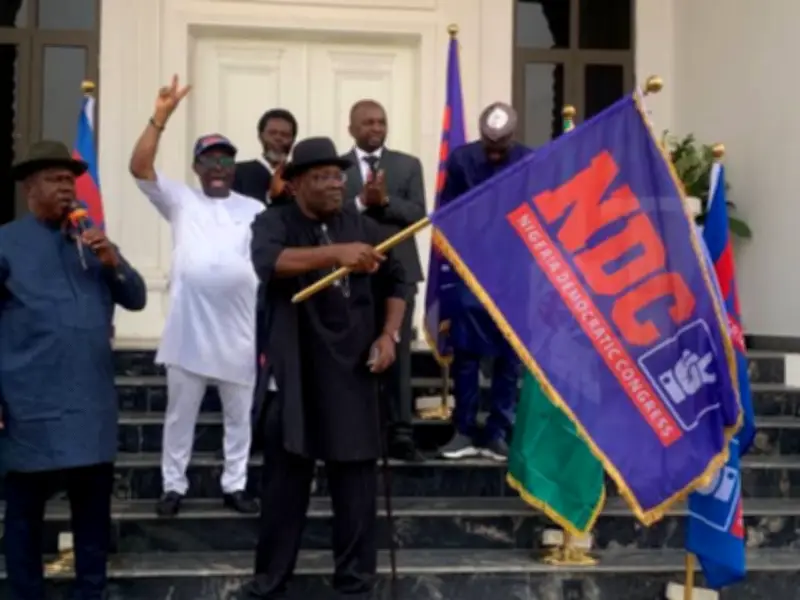
One of the most persistent misconceptions about the NDC is that it was hurriedly assembled as a vehicle for the 2027 presidential election. Party records and Dickson's own public statements show otherwise. The process of registering the NDC began as far back as 2017. For nearly nine years, the party existed as a vision that had to navigate administrative hurdles, repeated engagements with INEC, and the complex requirements of establishing a new national political platform. During those years, state coordinators were identified, grassroots structures were quietly developed, and individuals invested personal resources in building membership bases with no guarantee that the party would ever secure formal registration. This was not the work of a temporary electoral coalition. It was an attempt to create a durable political institution.
If the primary goal had been personal political advantage or financial gain, the rational decision would have been to align with the ruling party at various points. During the Buhari years, and again during the current administration, many politicians abandoned opposition platforms in search of accommodation. Dickson did not. Instead of joining the government of the day, a move that would have offered easier access to power and resources, he chose to remain in opposition and, more significantly, to invest in building an entirely new national party from the ground up. Building a political party in Nigeria demands years of financial commitment, organisational labour, and personal sacrifice with uncertain returns. That Dickson chose this route, rather than the more comfortable path of defection, undercuts any suggestion that the NDC was conceived as a purely transactional enterprise.
Defiance and Victory in Bayelsa
In Nigeria's often turbulent political landscape, few figures embody commitment to opposition principles and democratic pluralism as consistently as Senator Henry Seriake Dickson. The former Governor of Bayelsa State and current National Leader of the Nigeria Democratic Congress (NDC) has carved a reputation as a dogged opposition stalwart, refusing to compromise his convictions even amid immense pressure, federal might, and shifting alliances. His political journey reflects a deep-seated belief that a vibrant multi-party system is essential for healthy democracy, and that a drift toward one-party dominance poses a grave threat to Nigeria's progress.
Dickson's reputation for resilience was cemented during his tenure as Governor of Bayelsa State. In the 2015 gubernatorial election, amid the national “change” wave that swept the All Progressives Congress (APC) to power at the federal level under President Muhammadu Buhari, Bayelsa stood out as a PDP stronghold. Despite the full deployment of federal resources and machinery aimed at capturing the state, Dickson fought tenaciously and emerged victorious in a fiercely contested poll (later confirmed in a rerun). This victory, against the tide of national sentiment, established him as one of the most dogged political fighters of the modern era.
President Buhari reportedly made overtures to lure Dickson into the APC fold, offering promises of federal patronage and special recognition. Yet Dickson remained steadfast, prioritizing his principles over personal gain. His refusal to defect underscored his commitment to opposition politics and his belief in providing credible alternatives to the ruling party.
Senate Tenure and Opposition Advocacy
Elected to the Senate representing Bayelsa West, Senator Dickson has continued to champion opposition causes with vigor. Often described as a lone but consistent voice, he has spoken passionately on behalf of ordinary Nigerians, critiquing governance failures while advocating for accountability, good governance, and national unity. His interventions frequently reflect a balanced, nationalistic perspective, rising above narrow partisanship to address issues affecting the federation as a whole. Whether on security, economic reforms, or institutional strengthening, Dickson's contributions emphasize constructive opposition rather than outright confrontation.
Building the NDC as a National Platform
Central to Dickson's philosophy is the conviction that a one-party system is antithetical to true democracy. He has repeatedly warned against the risks of political monopoly, arguing that robust opposition and competition are vital for accountability and progress. This vision propelled him to initiate processes for registering the Nigeria Democratic Congress (NDC) as a viable national platform. When INEC lifted the embargo on new party registrations, while many politicians flocked to the APC, Dickson moved in the opposite direction. He reopened and championed the NDC, transforming it from a nascent entity into a national coalition attracting aspirants seeking genuine alternatives. Under his leadership, the party built grassroots structures across Nigeria's geo-political zones, drawing in influential figures early on, including Senator Kabiru Marafa from Zamfara, Senator Aishatu Binani from Adamawa in the North-East, and Amanda Pam in the North-Central region.
Dickson's doggedness, integrity, and proven leadership have been instrumental in attracting broader support. Prominent politicians such as Peter Obi and Rabiu Musa Kwankwaso eventually collapsed their respective movements (the Obidient movement and the Kwankwasiya movement) into the NDC. By the time they joined, the NDC was already gaining significant momentum as a credible national force. Their decision to adopt the NDC over more than 20 other parties was no coincidence; it stemmed from trust in Dickson's uncompromised values and the party's emerging structures and appeal as a vehicle for change from the status quo. Obi and Kwankwaso's alignment with the NDC, leading to Obi's emergence as the party's presidential candidate with Kwankwaso as running mate, highlighted the platform's growing stature. Dickson's role as a bridge-builder and kingmaker has positioned the NDC as a potent opposition force ahead of future elections.
Institution vs. Movement: The Core Tension
According to those involved in the party's formation, Obi and Kwankwaso were welcomed as partners in an institutional project, not as customers purchasing access to a ready-made structure. The distinction is important. A movement can be driven by the popularity of individuals. An institution is sustained by rules, structures, and collective responsibility. This original vision explains much of the current tension within the party. The debates over party supremacy, the integration of support groups, and the conduct of primaries are not random. They reflect the collision between the institutional philosophy on which the NDC was founded and newer tendencies that treat the party as a temporary vehicle for personal or group ambitions.
Across several states and the Federal Capital Territory, party organisers spent years building local structures, registering members, and investing personal resources long before the NDC entered national consciousness. Many did so because they believed they were helping to construct a lasting political institution rather than a short-term electoral arrangement. Their commitment helps explain the intensity of the current disagreements. For those who built the platform, the central question is not merely who can attract the largest crowds, but whether the original purpose of the party will be preserved.
Before the controversies surrounding the South East primaries, the disputes over party supremacy, or questions about accountability can be properly understood, the origin of the NDC itself must be established. The evidence points to a platform that began not with the arrival of celebrity politicians, but with years of quiet, consistent work by a politician who repeatedly chose the more difficult path of building opposition institutions when easier options were available. That history is not merely background. It is the lens through which everything that has followed must be viewed.
A Legacy of Principled Opposition
Throughout his career, Senator Henry Seriake Dickson has demonstrated that political longevity and influence need not come at the expense of conviction. From his early days supporting Jonathan, through his defiant governorship victory, to his current leadership of the NDC, he has consistently prioritized service to Bayelsa, the Ijaw nation, and Nigeria at large. His advocacy for multi-party democracy remains a bulwark against authoritarian drifts, reminding citizens and leaders alike that opposition is not mere dissent but a cornerstone of democratic vitality. As Nigeria navigates its complex political future, Dickson's trajectory serves as a compelling case study in principled opposition. In an era where expediency often trumps ideology, his steadfastness offers hope that genuine alternatives can emerge to strengthen the nation's democratic fabric.
Dr. Benedict Asemota is based in Baltimore and is a Public affairs analyst and researcher.