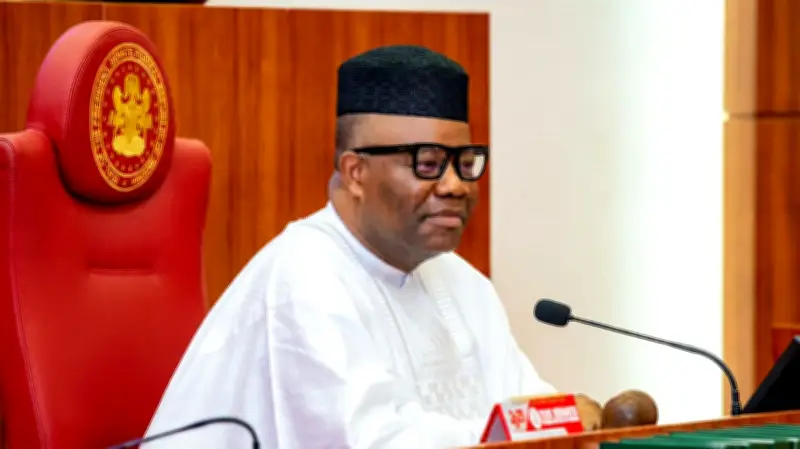
As Nigerians prepare for the 2027 general election, the increasingly hostile relationship between Senate President Godswill Akpabio and Senator Adams Oshiomhole reflects growing anxieties about the future balance of power within the National Assembly, AZIMAZI MOMOH JIMOH reports.
Disciplinary Action Looms
Consideration of possible disciplinary action against Senator Adams Oshiomhole during the Senate’s forthcoming emergency session on Tuesday has brought into sharper focus an emerging contest that may ultimately define the race for the leadership of the 11th Senate. Although the emergency sitting was officially convened to address the worsening security situation across the country, political attention has increasingly shifted to the implications of the growing tension between Senate President Godswill Akpabio and one of the most influential and outspoken members of the ruling All Progressives Congress (APC).
At first glance, the controversy centres on Oshiomhole’s comments regarding the suspension of Senator Natasha Akpoti-Uduaghan and his observations about the Senate report that recommended her six-month suspension. While Oshiomhole later clarified that he never accused the Senate of forgery, insisting that his comments had been misrepresented, the matter has nevertheless generated considerable anger within the Senate leadership. Senate spokesman, Senator Yemi Adaramodu, has already indicated that the upper chamber would examine the remarks and determine an appropriate response, fuelling speculation that sanctions may be considered against the former national chairman of the APC.
Deeper Political Struggle
Yet many observers believe the dispute extends far beyond parliamentary procedure. Rather, it appears to be an early manifestation of what could become a fierce struggle for influence ahead of the inauguration of the 11th Senate after the 2027 general election. Unlike previous election cycles, the composition of the next Senate is already attracting unusual attention because of the calibre of politicians who have secured tickets to either return to the chamber or make a comeback after years in executive office.
Among those that appear certain to participate in the next Senate are Senate President Godswill Akpabio, Deputy Senate President Barau Jibrin, Senate Leader Opeyemi Bamidele, former Delta State governor Ifeanyi Okowa, Imo State Governor Hope Uzodinma, former Senate Leader Ali Ndume, Tokunbo Abiru, Idiat Adebule, Wasiu Eshinlokun, Tahir Monguno, and several other experienced lawmakers. The emerging lineup suggests that the 11th Senate may be one of the most politically competitive assemblies since the return to democratic rule in 1999.
For Akpabio, this reality presents a challenge that differs significantly from the circumstances that produced his emergence as Senate President in 2023. At the time, he benefited from strong presidential backing, regional balancing considerations, and the absence of multiple heavyweight contenders within the APC caucus. The equation for 2027, however, may be considerably more complicated. Several incoming senators are expected to arrive with substantial political structures, national visibility, and independent power bases developed during their years as governors, ministers, or party leaders.
Oshiomhole’s Growing Influence
Political calculations within the APC have also become increasingly fluid as the party begins to contemplate succession arrangements beyond President Bola Tinubu’s second term. It is within this context that Oshiomhole’s growing disagreements with Akpabio have attracted heightened political significance. The former governor of Edo State is widely regarded as one of the few senators with the national stature, legislative experience, and political network capable of influencing the direction of a future leadership contest. Although he has not publicly declared any interest in the Senate presidency, Oshiomhole’s name routinely surfaces in discussions about possible leadership configurations in the next Assembly.
His credentials are difficult to ignore. Oshiomhole has served as president of the Nigeria Labour Congress (NLC), governor of Edo State, national chairman of the APC, and now senator representing Edo North. Few lawmakers possess a comparable blend of executive, legislative, and party administrative experience. This partly explains why some analysts view recent developments as more than a disagreement over Senate procedures. They argue that the widening gulf between Akpabio and Oshiomhole reflects growing anxieties about the future balance of power within the National Assembly.
Senate Standing Orders Dispute
The tension became particularly evident during debates on amendments to the Senate Standing Orders. Oshiomhole emerged as one of the strongest opponents of provisions that sought to restrict eligibility for principal offices to lawmakers who had served at least two consecutive terms. Although aspects of the amendments were eventually reviewed, his intervention was widely interpreted as a challenge to attempts by the current leadership to shape the rules governing future contests. In unusually direct remarks, Oshiomhole argued that Akpabio himself would not have qualified for the office he currently occupies under such requirements. The comment represented one of the most forceful public criticisms of the Senate President since the inauguration of the 10th Senate.
The dispute also highlighted a broader concern among some lawmakers regarding what they perceive as efforts to influence the political terrain ahead of 2027. For Akpabio, maintaining control of the Senate caucus and preserving institutional discipline are essential to any future leadership ambition. However, repeated confrontations with influential senators could complicate that objective. The challenge is further amplified by the calibre of politicians expected in the next Senate. Former governors traditionally exert considerable influence within the upper chamber because of their political experience, financial resources, and established networks across party lines. The anticipated arrival of figures such as Okowa and Uzodinma, alongside the return of several ranking senators, is expected to make the contest for principal offices considerably more competitive.
Akpabio’s Re-election Prospects
Indeed, it could be rightly argued that Akpabio’s ambition to retain the Senate presidency may prove far more difficult than his initial ascent to the office. Unlike in 2023, he may have to contend not only with opposition from rival blocs but also with ambitious power centres within his own party. The possibility of multiple aspirants from different geopolitical zones could further fragment support and make consensus-building more challenging.
Against this backdrop, any move to sanction Oshiomhole carries political risks. While it may reinforce the authority of the Senate leadership in the short term, it could also deepen perceptions that dissenting voices are being marginalised ahead of a potentially consequential leadership battle. Such perceptions may encourage the formation of alternative alliances among senators who believe the next Senate should not be dominated by a single political tendency.
For Oshiomhole, the confrontation equally carries significant implications. His reputation has long been built around challenging established authority and speaking openly against policies he considers unjust or undemocratic. That image continues to resonate with sections of the political class and the broader public. However, prolonged conflict with the Senate leadership could also isolate him within the institution and weaken his ability to influence future negotiations.
Uncertainty Ahead
As lawmakers prepare for Tuesday’s emergency session, uncertainty remains over whether the Senate will proceed with sanctions or seek a more conciliatory resolution. What is increasingly evident, however, is that the controversy has evolved beyond comments about Natasha Akpoti-Uduaghan’s suspension. Instead, it has become an early indicator of the intense political manoeuvring already underway ahead of the inauguration of the 11th Senate. With several political heavyweights preparing to take their seats and multiple centres of influence emerging within the APC, the contest for the next Senate presidency is shaping up to be one of the most competitive in recent history.