Atiku Abubakar Voices Regret Over 2015 Political Maneuver Against Jonathan
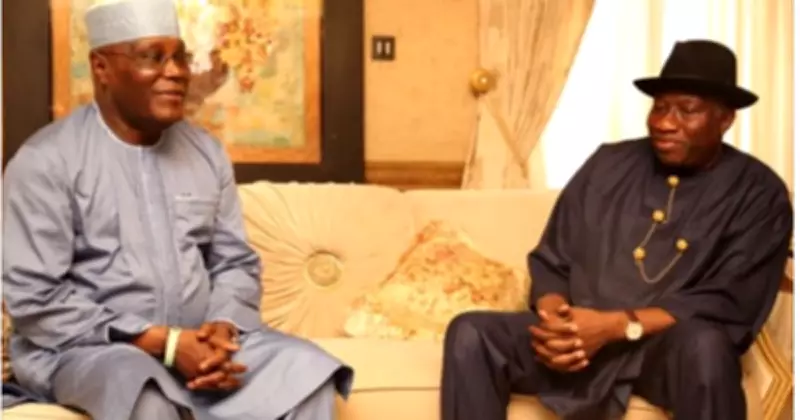
In a remarkable admission that has sent shockwaves through Nigeria's political landscape, former Vice President Atiku Abubakar has openly expressed regret for his instrumental role in the coalition that removed former President Goodluck Jonathan from power in 2015. The political heavyweight made these candid remarks during a significant media briefing with opposition leaders in Abuja on Thursday, February 26th, 2026.
A Coalition That Backfired
Atiku Abubakar, who served as Nigeria's vice president from 1999 to 2007 under President Olusegun Obasanjo, revealed that the issues that prompted the formation of the All Progressive Congress (APC) opposition coalition in 2014 have now escalated far beyond their original scope. "We came together and formed APC because we felt democracy was faulty in 2014, only to end up worse," stated the Turaki of Adamawa, using his traditional title.
The former vice president elaborated that the coalition, which successfully ended the People's Democratic Party's sixteen-year reign in power, ultimately set the country back rather than moving it forward. This admission comes as Nigeria approaches another critical election cycle, with Atiku emphasizing the urgent need to restore true democracy to the nation.
Historical Context of the APC Formation
The political merger that created the APC represents one of Nigeria's most significant opposition movements in recent history. In February 2013, three major opposition parties—the Action Congress of Nigeria (ACN), Congress for Progressive Change (CPC), and All Nigeria Peoples Party (ANPP)—joined forces with a faction of the All Progressives Grand Alliance (APGA) to establish what they called the All Progressive Conference (APC).
Atiku Abubakar played a pivotal role in this political realignment by leading a substantial group of PDP members to defect to the newly formed APC, significantly strengthening the opposition's position. This strategic move proved successful when APC candidate Muhammadu Buhari, a former military head of state, defeated incumbent President Goodluck Jonathan in the 2015 presidential election.
Political Repercussions and Future Ambitions
Despite the initial success of the APC coalition, the alliance proved unstable. Atiku Abubakar eventually returned to the PDP, using that platform to challenge President Buhari in 2019 and current President Bola Ahmed Tinubu in 2023. The former vice president has maintained an active presence in Nigerian politics, having contested presidential elections in 2007, 2019, and 2023.
Political observers now anticipate that Atiku will seek the presidential nomination of the African Democratic Congress for the upcoming 2027 elections, which would mark his fourth presidential campaign. The National Electoral Commission has recently updated the election schedule, with presidential elections currently slated for January 16, 2027.
Opposition Gathering and Democratic Renewal
The press conference that featured Atiku's revealing remarks included numerous prominent opposition figures, demonstrating a concerted effort to challenge the current administration. Attendees included:
- Former Governor of Anambra State
- Former Senate President David Mark
- Former Osun State governor Rauf Aregbesola
- Former Rivers State governor Rotimi Amaechi
- National Chairman of the New Nigeria Peoples Party (NNPP), Ahmed Ajuji
- NNPP major stakeholder Buba Galadima
Atiku used the platform to issue a rallying cry to opposition forces, declaring, "We must succeed to make sure we restore true democracy to our country." This statement underscores the growing momentum as Nigeria prepares for another consequential election cycle that will test the resilience of its democratic institutions.
The former vice president's public regret represents a significant moment in Nigeria's political narrative, highlighting the complex consequences of political alliances and the ongoing struggle for democratic governance in Africa's most populous nation.