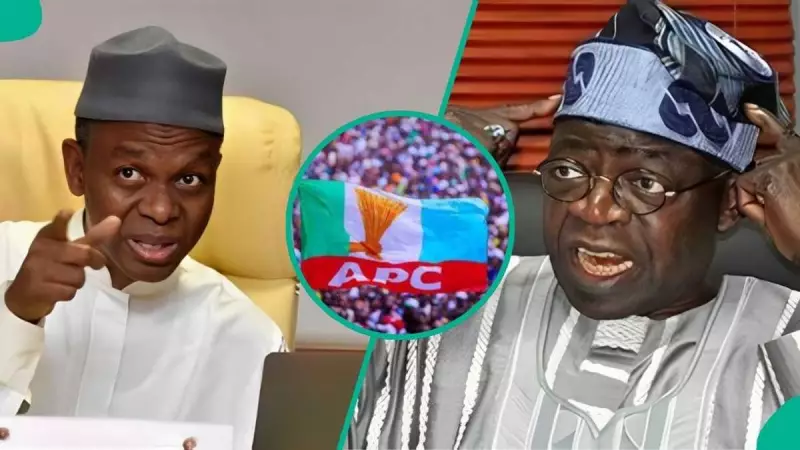
In a significant political commentary, former Kaduna State Governor Mallam Nasir El-Rufai has declared that Nigeria does not operate with a permanent ruling party, emphasizing that political power remains contestable and subject to change. El-Rufai specifically pointed to the upcoming 2027 general election as a potential turning point where the current ruling party could face displacement.
APC's Future in Question: El-Rufai Draws Parallels with PDP's 16-Year Reign
Reflecting on Nigeria's democratic trajectory, El-Rufai drew direct comparisons between the current All Progressives Congress (APC) administration and the previous Peoples Democratic Party (PDP) government. He recalled that the PDP governed Nigeria for sixteen uninterrupted years before losing power in the 2015 elections, suggesting a similar political fate could await the APC.
"The PDP ruled for 16 years. The APC will not govern forever. It is likely that in 2027 the APC will be gone," El-Rufai stated unequivocally during his remarks.
Nigeria's Democratic Distinction: Contestable Power as National Strength
El-Rufai highlighted what he considers a fundamental strength of Nigeria's political system compared to other African nations. He noted that Nigeria's ability to facilitate opposition parties winning elections and unseating incumbents distinguishes it from dominant-party systems observed in countries like Uganda, Tanzania, Rwanda, Benin, and Togo.
"Nigeria does not have a permanent ruling party. That is an achievement compared to countries like Uganda, Tanzania, Rwanda, and even our neighbours, Benin and Togo," he explained. "Power, therefore, remains contestable, and that is a major strength of Nigeria's democracy."
Political Competition Without Accountability: El-Rufai's Critical Warning
Despite acknowledging this democratic advantage, El-Rufai issued a serious warning about the current state of Nigeria's political development. He argued that while electoral competition exists, it has not yet matured into meaningful accountability, strong institutions, or consistent good governance.
"Competition has not yet matured into accountability and good governance," El-Rufai cautioned, pointing to what he sees as a significant gap in Nigeria's political evolution.
Weak Party Structures and Personality-Driven Politics
The former governor elaborated on his concerns about institutional development, suggesting that elite circulation has progressed faster than the strengthening of political structures. He characterized Nigerian political parties as weak, personality-driven, and transactional rather than being built on solid ideology or robust internal frameworks.
"Parties remain weak, personality-driven and transactional," El-Rufai noted, identifying this as a fundamental challenge to sustainable democratic development.
Economic Progress and Industrial Development: Selective Gains Acknowledged
Beyond political commentary, El-Rufai also addressed Nigeria's economic landscape, acknowledging that the country has experienced selective economic and industrial progress over recent years. He attributed these gains to periods characterized by macroeconomic discipline and strategic infrastructure investment.
"Nigeria has experienced selective economic and industrial gains. There are years of growth driven by macroeconomic discipline and infrastructure investment," he observed.
Dangote Refinery as Strategic Asset for National Self-Sufficiency
Highlighting specific industrial developments, El-Rufai pointed to the Dangote Refinery as a crucial strategic asset that could reposition Nigeria toward self-sufficiency in critical sectors. He emphasized its potential impact on refined petroleum, petrochemicals, and fertilizer production.
"The Dangote refinery positions Nigeria towards self-sufficiency in refined petroleum, petrochemicals and fertiliser," he stated, while simultaneously stressing that sustained progress would require stronger institutions, credible political parties, and comprehensive governance reforms that extend beyond mere electoral competition.
Political Reactions and Broader Implications
El-Rufai's comments have generated substantial debate within Nigerian political circles, particularly as the country looks toward the 2027 general election. His remarks touch on fundamental questions about the future of the APC, the maturity of Nigeria's democratic system, and the relationship between political competition and governance quality.
The former governor's perspective adds to ongoing discussions about political accountability, institutional development, and the cyclical nature of power in Nigeria's evolving democracy. His warning about the gap between electoral competition and substantive governance improvements presents a critical challenge for Nigeria's political class as the nation approaches another significant electoral cycle.