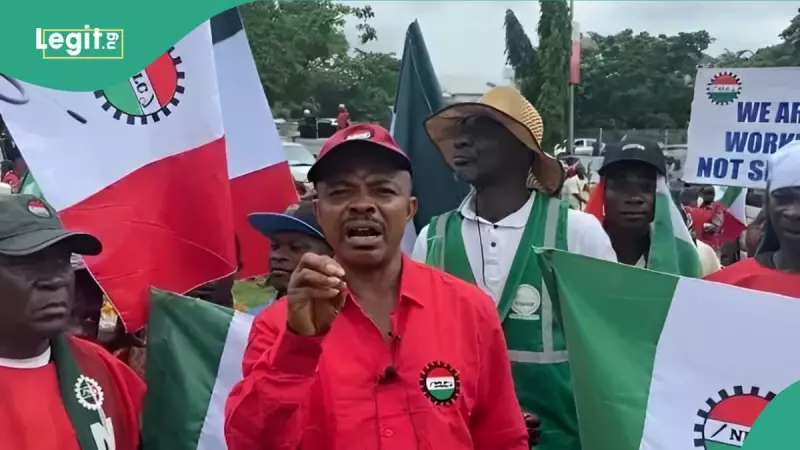
NLC Declares War on Wike's FCTA Administration Amid Escalating Strike
The Nigeria Labour Congress has dramatically escalated its confrontation with the Federal Capital Territory Administration, declaring what it terms a "war" against the political leadership under Nyesom Wike. This declaration comes as the ongoing indefinite strike by FCT workers enters a critical phase, with the labour movement mobilizing for a significant court showdown.
Mass Mobilization Ordered for Industrial Court Appearance
In a decisive move, the NLC has directed all Federal Capital Territory Administration workers to mobilize en masse to the National Industrial Court on Monday, January 26, 2026. This directive represents a strategic escalation of the industrial action that has already paralyzed administrative services across Abuja. The Congress emphasized that the court premises must be "filled with the dignified presence of the working class" as a powerful demonstration of unity and resolve.
NLC President Joe Ajaero has issued firm instructions to all affiliate unions to fully align with the strike action, ensuring complete solidarity across the labour movement. The Congress has ordered an immediate intensification of the industrial action throughout the Federal Capital Territory, signaling their determination to maintain pressure until their demands are met.
Serious Allegations Against FCTA Leadership
Joe Ajaero has leveled grave accusations against the FCTA management and its political leadership, citing multiple violations of workers' rights. The allegations include wage abuse, pension diversion, intimidation of workers, and what the NLC describes as gross violations of both constitutional and international labour standards. These charges form the core justification for the intensified strike action.
In a statement issued on Friday, January 23, 2025, Ajaero declared that "the patience of the working class is exhausted" and emphasized that "their ultimatum was and remains our ultimatum." This strong language underscores the NLC's commitment to seeing this conflict through to resolution.
Spiritual and Strategic Dimensions of the Struggle
In an unusual but significant development, the Nigeria Labour Congress has announced compulsory daily prayer and solidarity sessions for workers across the Federal Capital Territory. These gatherings will take place from 8:00 a.m. to 5:00 p.m. daily, described by the NLC as spiritual and moral assemblies designed to sustain worker morale and unity throughout the struggle.
The Congress has framed this conflict as extending beyond traditional labour issues, declaring it has become "a broader people's struggle." Ajaero has mandated trade unions to immediately form strategic alliances with various stakeholders, including:
- Civil society organizations
- Student groups
- Community activists
- Other concerned stakeholders
Background of the Escalating Conflict
The current crisis traces back to Monday, January 19, 2026, when activities at both the Federal Capital Territory Administration and Federal Capital Development Authority were completely halted as workers began their indefinite strike. This action was called by the Joint Union Action Committee, with union leaders ordering staff to remain at home while deploying task forces to ensure full compliance with the industrial action.
The FCTA management has yet to issue an official response to these developments, raising serious concerns about the continued disruption of essential administrative services in Nigeria's capital city. This silence has only intensified the determination of the labour movement.
Previous Protests and Minimum Wage Issues
This confrontation follows earlier protests that saw hundreds of health professionals, teachers, and other workers marching from the Labour House in Central Area to Nyesom Wike's office. The protesters carried placards demanding implementation of the N70,000 minimum wage for council workers, highlighting long-standing grievances that have now reached a boiling point.
Following these protest actions, Wike summoned area council chairmen to question why the minimum wage had not been implemented, though this intervention appears to have failed to prevent the current escalation. The Nigeria Labour Congress now positions this struggle as "the struggle of every worker in the FCT," indicating their determination to achieve comprehensive resolution of these labour issues.