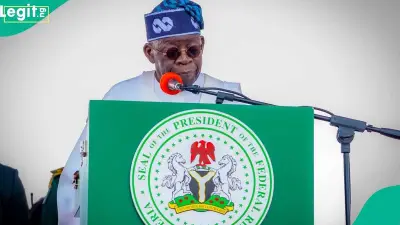
The political landscape in Nigeria witnessed an unusual confrontation this week as senior aides to President Bola Tinubu and former Vice President Atiku Abubakar engaged in a heated public debate over grammatical correctness and security policy. The exchange, which played out on the social media platform X, highlighted the intense rivalry between Nigeria's top political figures and their communication teams.
A Twitter War Over Grammar and Governance
The drama began when Bayo Onanuga, Special Adviser on Public Communication to President Tinubu, took to his X handle @aoanuga1956 to address a security concern. Onanuga called for severe action against vandals disrupting rehabilitation work on the Ilesha-Ibadan Expressway, suggesting they should be "shot at sight." His tweet, posted at 8:09 am on Sunday, described the vandals as "the worst species of citizenships" and sparked immediate controversy.
Phrank Shaibu, Senior Special Assistant to former Vice President Atiku Abubakar, quickly responded through his X handle @phrankangel. Shaibu condemned Onanuga's remarks as "lawlessness," arguing that a government spokesman should not advocate for citizens to be shot without due process. "That is not law enforcement, it is lawlessness," Shaibu stated firmly. "Anyone who talks like this has no business in public office."
The Grammatical Battle Intensifies
Later that evening, Shaibu returned to the conversation with a different critique. He pointed out what he considered a grammatical error in Onanuga's original post, arguing that the correct expression should be "shoot on sight" rather than "shoot at sight." At 9:37 pm, Shaibu detailed his linguistic objection, suggesting that proper grammar matters in public communication.
Onanuga fired back early Monday morning with a dismissive response: "Foolish boy. Both usages are correct. Upgrade your grammar." This only fueled the exchange further, as Shaibu elaborated on his position with detailed linguistic analysis. He explained that "shoot on sight" represents a fixed idiom that should not be altered, comparing potential variations to other common grammatical errors.
Shaibu's detailed response included specific references to language rules:
- Fixed idioms maintain consistent structure and meaning
- "Shoot at sight" represents what he called "weak heads" in language usage
- Such expressions should not be considered stylistic variants but errors
- He recommended Brighter Grammar textbooks for clarity
Broader Political Context and Implications
This exchange between senior media managers of Nigeria's leading political rivals reflects deeper tensions within the political landscape. The grammatical debate serves as a proxy for broader disagreements about governance style, communication standards, and political philosophy. Both aides represent figures who have been central to Nigeria's political discourse for decades, making their public sparring particularly significant.
The incident also highlights how social media has become a primary battleground for political messaging in Nigeria. What might have been a private disagreement in previous eras now plays out in real-time before millions of followers, with each side seeking to score political points through linguistic precision and policy positions.
Previous Controversies and Political Positioning
This is not the first time Onanuga has made headlines for his strong statements. Previously, he downplayed the political strength of Peter Obi, describing him as lacking the leadership pedigree to govern Nigeria. This came after Obi formally joined the African Democratic Congress in December 2025, bringing several supporters with him and potentially strengthening the opposition platform.
Similarly, Shaibu has been active in defending his principal against criticism. He recently criticized Senator Adams Oshiomhole for claiming Atiku lacks governing capacity, accusing Oshiomhole of hypocrisy given the APC's performance under his influence. Shaibu pointed to Atiku's economic reforms as Vice President as evidence of his leadership credentials.
The ongoing exchange demonstrates how political communication has evolved in Nigeria's digital age, where grammatical precision and policy positions receive equal scrutiny in the public arena.