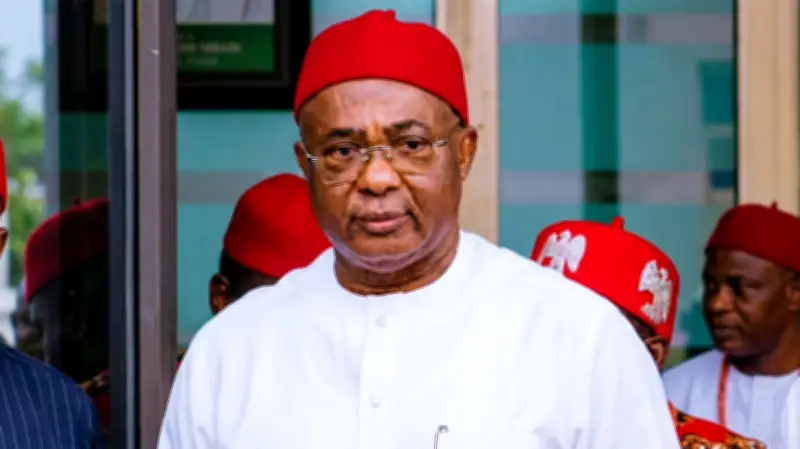
As the political clock ticks towards the 2027 elections, a familiar dynamic unfolds: those out of power seek to displace incumbents, while incumbents strive to consolidate their positions. Imo State Governor, Hope Uzodimma, firmly belongs to the latter group, pursuing a return to the Senate that he left barely seven years ago to become governor. Lawrence Njoku examines this strategic move.
A Political Career Defined by Persistence
Governor Uzodimma appears to speak only the language of politics. Since joining the National Party of Nigeria (NPN) during the Second Republic as a youth leader in Imo State, he has remained relevant across political eras, often switching parties. With the return of democracy in 1999, he joined the Peoples Democratic Party (PDP), serving in various capacities and contesting elections. In 2011, he was elected to the Senate for Imo West, serving until 2019 when he ran for governor on the All Progressives Congress (APC) ticket. The Supreme Court declared him winner in 2020, and he began his tenure.
By January 2027, Uzodimma will have completed three years of his second term. However, those expecting him to serve until January 15, 2028, may be disappointed: he has indicated his intention not to complete his term, instead vying for the Imo West Senatorial District seat. He has already secured his party's ticket. If he wins the general election, he must resign as governor by June 2027, as the Constitution and Electoral Act prohibit holding two elective offices simultaneously. This would mean forfeiting the remainder of his gubernatorial tenure to represent just one-third of the state.
Section 183 of the Constitution explicitly bars a governor from holding any other executive office or paid employment, requiring resignation upon assuming another office. Thus, Uzodimma would remain governor until the next National Assembly is proclaimed in June 2027, but questions linger: will he truly quit the governorship for a Senate seat, and will he leave without influencing his succession?
Succession Speculations and Motives
Reports from Imo State suggest that Uzodimma may not leave without a hand in who completes his term. Recently, his deputy, Mrs. Chinyere Ekomaru, was reportedly pressured to resign. Unconfirmed claims indicate this move would allow Uzodimma to appoint a loyal successor from Orlu zone as deputy and an interim governor from Owerri zone. Ekomaru became deputy in 2023, replacing Prof. Placid Njoku, with Uzodimma stating it added value to his ticket and appreciated women's contributions.
As the state watches how he navigates this succession puzzle, the driving force behind his Senate ambition remains a topic of debate. Uzodimma has stated he aims to serve his people and President Bola Tinubu by enacting laws for national development. He said, "My dear people of Imo West have once again called upon me to serve, and I have accepted this noble call with utmost humility." He added that his aspiration supports the Tinubu administration through "quality representation, effective legislation, enhanced development and sustainable progress."
However, pundits argue it is purely self-serving. They question his legislative record during eight years as senator and why he cannot allow another politician from his zone to continue. Sources suggest his real goal is to become Senate President should Tinubu win re-election in 2027. With Tinubu and Vice President Kashim Shettima both Muslims, the party may prefer a Christian Senate President from the South-South or Southeast. Uzodimma, as chairman of the Progressive Governors' Forum and leader of the Renewed Hope Ambassadors backing Tinubu's second term, is well-positioned.
Rumours also point to 2031, when power may rotate to the North. If Shettima remains vice president, he might run for president, and Uzodimma as Senate President could bargain to become his running mate or secure another top role.
Criticism from Analysts
Political scientist Dr. Levi Agunwa described Uzodimma as a "desperate" politician who leaves nothing to chance. "You were in the Senate for eight years and left to become governor. Now, less than eight years later, you want to return. Does that mean the Imo West seat is reserved only for Uzodimma? Natural justice should allow another part of your constituency to produce the next senator in 2027," he said.
Donald Eberechi, an African Democratic Congress chieftain in Imo, echoed this, blaming such attitudes for distorting Nigeria's democracy. "How come it is difficult for our politicians to let others taste power? Uzodimma is not going to the Senate to push for better legislation; he wants to occupy a position for future bargains. If I were him, I would support a younger person and stay back to offer advice. That is how statesmen are made."
Political analyst Jude Obiorah argued that the Southeast would not necessarily benefit from Uzodimma becoming Senate President. "The zone wants a fair share in power. Becoming number three means nothing. All Uzodimma wants is to serve Tinubu, not the Southeast. When you have a man in such a desperate situation, it is as good as not having representation." Obiorah noted that Uzodimma's governorship has largely been spent in Abuja, not in the state he was elected to serve, indicating he prefers proximity to the presidency.
He concluded that politicians use democracy to create opportunities for themselves, discouraging competition and harming the system.