The race for global influence in the twenty-first century is no longer solely about natural resources like oil or gold. The true determinants of future power are effective governance, the ability to harness human potential, and the creation of enduring institutions. As artificial intelligence, climate change, and shifting global alliances reshape the world, a critical question emerges: which nations will seize leadership, and which will fall behind?
Africa's Defining Moment and the Leadership Imperative
Africa stands at the centre of this global shift. The continent is currently home to 1.4 billion people, a figure projected to soar to nearly 2.5 billion by 2050. Soon, forty percent of the world's youth population will be African. This demographic reality makes Africa an undeniable force on the world stage. However, population numbers alone are not enough to guarantee prosperity or influence.
The continent's ultimate trajectory will be shaped by the quality of its leadership, the resilience of its public institutions, and the dedication of its civil servants. Without these foundational elements, even the most well-intentioned plans and ambitious governments can fail to deliver meaningful progress for their citizens.
The Inside-Out Strategy of the Aig-Imoukhuede Foundation
This core belief drives the mission of the Aig-Imoukhuede Foundation. Established by Aigboje and Ofovwe Aig-Imoukhuede, the foundation operates with a strategic, behind-the-scenes focus on improving lives across Africa by fundamentally transforming how public services are delivered. Its methodology is distinct: instead of funding external projects, it invests directly in people. The foundation cultivates ethical, high-capacity leaders who are positioned to reform institutions from the inside.
Africa possesses immense ambition, creativity, and natural resources. Yet, this potential is frequently stifled by significant governance gaps. Policies often remain unimplemented documents, budgets are not optimised for impact, and institutions are burdened by outdated systems or leadership unable to adapt. These deficiencies do more than slow development; they erode public trust, deter investment, and leave citizens without essential services.
The Aig-Imoukhuede Foundation counters this by empowering public servants directly. It provides them with critical skills, professional networks, and the confidence to become drivers of internal change. The philosophy is straightforward: sustainable development is only possible when the individuals and systems responsible for it are truly capable.
Forging Global Partnerships for Local Impact
A cornerstone of the foundation's strategy is its partnership with the University of Oxford's Blavatnik School of Government. This alliance connects emerging African leaders with global best practices in public policy. The scholars and fellows who study at Oxford do so with a clear, non-negotiable mandate: they must return to their home countries and apply their knowledge to transform their institutions. The goal is not to create expatriates, but to build a powerful cohort of domestic reformers.
The AIG Scholarship, fully funded by the foundation, enables exceptional public servants to pursue a Master of Public Policy at Oxford. The critical condition is their commitment to return and lead institutional reform. To date, 33 scholars have moved from Oxford's classrooms into pivotal roles within African governments, equipped to enact tangible change.
Examples of this impact are already evident. Abdul-Fatawu Hakeem, Head of Debt Policy and Risk Management at Ghana's Ministry of Finance, applied his Oxford training directly to the country's national debt restructuring programme, influencing economic stability and fiscal strategy. The current 2025 scholar, Oluwapelumi Olugbile from NIGCOMSAT, is focused on ensuring every naira of government spending delivers maximum public value.
Transforming Public Service Training from Within
The 2025 AIG Fellow, Funke Adepoju, who is the Director-General of Nigeria's Administrative Staff College (ASCON), embodies this mission of internal transformation. She is addressing a long-standing weakness in African public sector training: an over-reliance on theory that fails to produce graduates capable of implementing practical reform.
Her fellowship research at Oxford tackles a transformative question: how can public training institutions become genuine engines of reform? Mrs. Adepoju is developing new models that integrate digital transformation, measurable performance outcomes, and innovation-driven curricula. Her vision is to reposition ASCON as a national hub for driving Nigeria's Federal Civil Service Strategy and Implementation Plan (FCSSIP-25), moving beyond a traditional training school to an active reform catalyst.
The Ripple Effect: A Network of Changemakers in Action
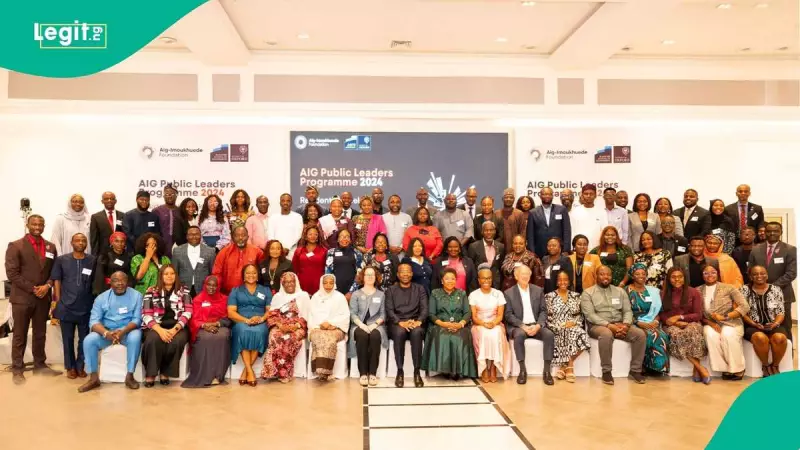
Sustainable change requires more than individual leaders; it demands strong teams and reformed institutions. The AIG Public Leaders Programme (PLP) builds powerful networks of reform-minded officials and ensures learning translates into immediate action. Participants identify real-world problems within their agencies and implement solutions as a core part of their training.
The tangible results of this approach are impressive and widespread:
- Titilola Vivour-Adeniyi in Lagos created a secure digital platform to protect survivors of abuse and evidence, strengthening the justice system for thousands.
- Idowu Bakare at the National Assembly developed a dashboard to track bills and automate legislative processes, enhancing transparency for millions of Nigerians.
- Abraham Oludolapo designed a nationwide policy to combat sexual harassment within the National Youth Service Corps, safeguarding over 400,000 corps members and staff annually.
- The Nigerian Airspace Management Agency developed Africa's first standardized on-the-job training manual for Air Traffic Safety Electronics Personnel, boosting aviation safety.
- The National Agency for Food and Drug Administration and Control automated its dossier review, clearing a 15-year backlog and speeding up access to vital medicines.
- At Lagos's Isheri Olofin Primary Healthcare Centre, patient wait times were slashed from 82 minutes to 31 minutes.
These are not pilot projects; they are institutional reforms executed from within, sustained by enhanced skills, courage, and professional networks.
Investing in the Engine Room of the State
The Aig-Imoukhuede Foundation distinguishes itself through an unwavering focus on measurable impact. Its scholars, fellows, and PLP graduates form a continuous pipeline of change-agents embedded deep within government structures. The return on this investment is not measured in diplomas, but in more efficient processes, faster service delivery, greater transparency, and the gradual restoration of public trust.
Africa's most significant opportunity is now clear: invest in the people who manage the system, and the system itself will improve. The work of the 2025 AIG Scholar, the 2025 AIG Fellow, and the expanding network of PLP alumni demonstrates a powerful truth. When you invest in capable and ethical public servants, you do more than change individual careers; you transform institutions, strengthen economies, and ultimately, improve the lives of millions.
For business leaders, philanthropists, and policymakers, the lesson is straightforward. If you desire a functional and prosperous Africa, the most strategic investment you can make is in its public service. Here, in the often-overlooked engine room of the state, the continent's future is being built. Its endurance will be secured not by physical infrastructure alone, but by the leaders who ensure it works for everyone.