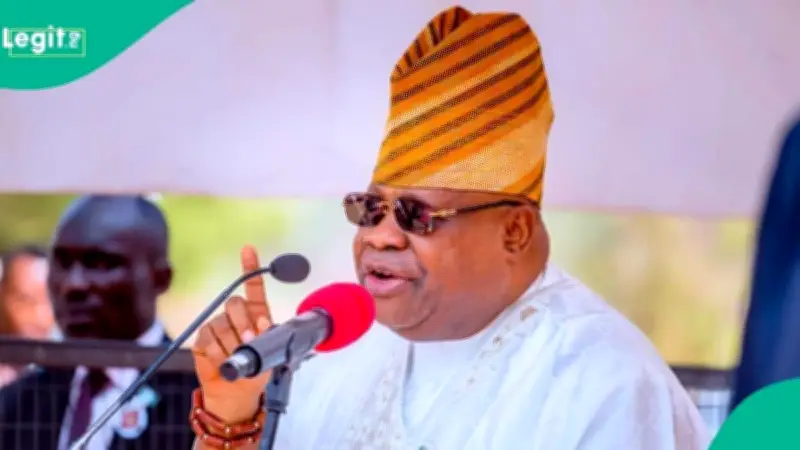
Public affairs analyst Donald Okwuosa has attributed Governor Ademola Adeleke's victory in the August 15, 2026 Osun State governorship election to three key factors: incumbency, voter trust in infrastructure delivery, and the support of entertainer Davido. Adeleke, who defected from the Peoples Democratic Party (PDP) to the Accord Party, secured a decisive win over his closest rival, Bola Oyebamiji of the All Progressives Congress (APC).
Adeleke's Defection Strategy and Its Impact
Okwuosa stated that Adeleke's decision to leave the PDP before the election was a defining move. He explained that internal divisions had weakened the PDP, which he attributed to the influence of APC operatives working to destabilise Adeleke from within. By switching to Accord while retaining his status as sitting governor, Adeleke preserved his political identity without being dragged into a damaging party crisis.
Okwuosa made these remarks during an exclusive chat with Legit.ng on the assessment of the outcome of the Osun gubernatorial election.
Three Factors Behind the Victory
According to Okwuosa, the first factor was the combination of incumbency and the defection strategy. Adeleke's name recognition as a serving governor proved more powerful than his party affiliation, suggesting that in Osun's political environment, the individual still outweighs the platform. During his campaign, Adeleke told supporters: "NO SHAKING, Imole is coming back," projecting confidence in his record.
The second factor was visible infrastructure delivery in key strongholds including Osogbo, Ilesha, Iwo, and Ede, which helped consolidate voter loyalty. Okwuosa noted that residents in these areas backed Adeleke because of tangible projects rather than party loyalty alone, and that support from entertainer Davido contributed to his appeal.
The third factor was the conduct of the election itself. The Independent National Electoral Commission (INEC) deployed the Bimodal Voter Accreditation System (BVAS) and transmitted results to the IReV portal, the same framework used in Ekiti State. Okwuosa flagged vote buying as the most alarming issue going into the poll, but commended Osun voters for remaining at polling units to protect their ballots.
Implications for 2027 Elections
Okwuosa said Adeleke's victory on a new party platform disrupts the APC's strategy in the Southwest ahead of the 2027 general elections, adding to losses the party has suffered in the region. For the PDP, the loss of a sitting governor to another party signals deeper instability within its structures.
He also noted that President Bola Tinubu losing influence in his home region, combined with existing tensions between his administration and the Adeleke family and public remarks by Davido suggesting the family would not back Tinubu for the presidency, creates a political problem Tinubu will need to address before 2027.
Call for National Electoral Reform
On the electoral process, Okwuosa called on INEC to replicate the Osun template at the national level, saying the election restored some public confidence. "No more 'Glitch in Server' or 'BVAS malfunctioning' come 2027," he said.
Earlier, Legit.ng reported that INEC's returning officer declared Accord candidate Ademola Adeleke the winner of the Osun State governorship election. Adeleke polled 511,067 votes against APC's Bola Oyebamiji, who scored 444,815 votes in the keenly contested poll. Nigerians took to social media to share strong reactions to the result, with many linking the outcome to the 2027 general elections.