
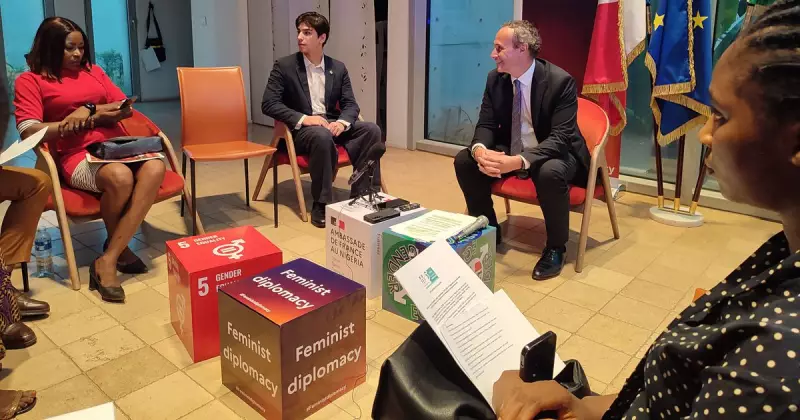
In a significant move to bolster gender equality and economic opportunities for women, the French Embassy in Nigeria has officially rolled out a major new initiative. The FEF-OSC Programme represents a cornerstone of France's feminist foreign policy, directly targeting the empowerment of women and girls across the nation.
A Partnership Built on Co-Creation, Not Instruction
During a press briefing held in Abuja on Thursday, December 5, 2024, French Ambassador Marc Fonbaustier detailed the programme's innovative approach. He stressed that the initiative was not designed in Paris and imposed on Nigeria. Instead, it was developed through close collaboration with Nigerian Civil Society Organisations (CSOs) and the Federal Ministry of Women Affairs.
"We adopted a model of co-construction, moving away from a top-down system," Ambassador Fonbaustier explained. "This collaborative process led us to identify and support 21 distinct projects spread across 16 states in Nigeria. This method guarantees that every intervention is finely tuned to local realities, needs, and community priorities."
Targeted Impact and Remarkable Social Returns
The selected projects under the FEF-OSC umbrella focus on several critical areas essential for women's advancement and community resilience. These key sectors include:
- Economic empowerment and entrepreneurship
- Building climate change resilience
- Promoting peace and security
- Preventing and addressing gender-based violence
The programme has already demonstrated impressive efficiency. Ambassador Fonbaustier revealed that an analysis showed an average Social Return on Investment (SROI) of 4.3. In practical terms, this metric indicates that for every single naira invested into the programme, an equivalent value of 4.3 naira is generated or saved for the benefit of women, their families, and local administrations.
Embedding Sustainability for Long-Term Change
A core principle of the FEF-OSC Programme is ensuring its work continues beyond initial funding. To achieve this, the participating CSOs have proactively secured 546 formal partnerships with a wide range of local actors.
These crucial alliances include federal and state ministries, private sector companies, and traditional rulers. By embedding their projects within existing local institutions and market systems, the initiative builds a foundation for lasting impact.
Ambassador Fonbaustier highlighted the indispensable role of civil society, stating, "Civil society organisations cannot be the only partners, but their specific skills, grassroots location, and operational agility make them truly irreplaceable." He reiterated that France's ongoing engagement in Nigeria is rooted in a commitment to equitable partnerships and promoting local ownership of development projects.
The Ambassador also pointed to the programme's success as a valuable blueprint for other international donors. By prioritising co-creation with local organisations, development efforts can achieve sustainable, context-specific outcomes that directly transform communities.
In his closing remarks, Fonbaustier acknowledged the vital role of journalists in ensuring transparency and effective communication. "When journalists perform their duties well, the public receives accurate information. Our shared goal is what is best for the communities of Nigeria," he concluded.
The FEF-OSC Programme is now positioned as a model for future initiatives aimed at promoting gender equality and women's empowerment. It stands as clear proof that with the right support, civil society organisations can deliver truly transformative social and economic impact.




