
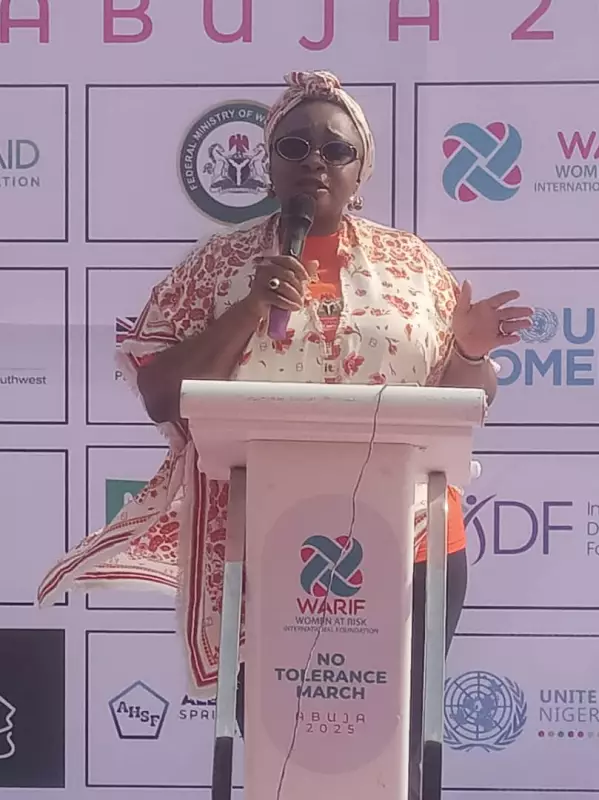
The Federal Government has pledged to strengthen legal protections against digital violence, with the Minister of Women Affairs, Hajiya Imaan Sulaiman-Ibrahim, declaring that ongoing legal reforms will comprehensively address all forms of online harm. This commitment was central to the 2025 No Tolerance March held in Abuja on Saturday, an event marking the global 16 Days of Activism Against Gender-Based Violence.
March Highlights Urgent Need for Digital Safeguards
Leading the procession, Minister Sulaiman-Ibrahim emphasized that the Ministry of Women Affairs is actively bolstering protective measures. She reaffirmed President Bola Tinubu's commitment to the welfare and safety of every Nigerian citizen. The Minister presented alarming data, noting that community reports indicate eight out of every ten Gender-Based Violence (GBV) cases involve minors.
She issued a stark warning about the misuse of technology, stating it is increasingly weaponized to harm women and girls. "Before legal reforms are completed, we must strengthen protective measures against all forms of digital violence," Sulaiman-Ibrahim asserted. She also commended law enforcement agencies and development partners for their support in seeking justice for survivors.
National Call for a Survivor-Centered Approach
The march, which was simultaneously held across 19 states to empower grassroots communities with knowledge of their rights, featured strong statements from various leaders. Dr. Zainab Shinkafi-Bagudu, former First Lady of Kebbi State and CEO of Medicaid Cancer Foundation, praised the Ministry's leadership. She highlighted that the global theme, "Uniting Against Digital Violence," mirrors the critical need to combat evolving threats and advocated for a survivor-centered approach to safeguard families and communities.
Senator Ireti Kingibe, Chairperson of the Senate Committee on Women Affairs, stressed that ending GBV and achieving women's inclusion in governance is a collective responsibility. She urged Nigerian women to demand their space in leadership, identifying violence as a major barrier to participation. "Even people like me are sometimes afraid. Younger, more vulnerable women feel it even more. But it must stop—and it will stop when we insist on it," Senator Kingibe stated.
Institutional Commitments and Inclusive Advocacy
Representing the Nigeria Police Force, AIG Dr. Aishatu Abubakar Baju reaffirmed the institution's zero-tolerance stance on GBV. She pointed to the nationwide Police Women’s Walk and the recent launch of the Nigerian Police Gender-Based Violence Training Manual and Standard Operating Procedure as concrete steps. She clarified that the Inspector-General of Police has mandated the protection of survivors and accountability for perpetrators.
Advocacy for inclusive protection was loud and clear. Lois Auta, CEO of the Network of Women with Disabilities, declared that the march symbolized inclusion and human rights, emphasizing that women and girls with disabilities face disproportionately higher risks of violence. Adeola Potts-Johnson, Project Manager at Women At Risk International Foundation (WARIF), challenged the culture of silence around sexual violence, unequivocally stating, "Rape is never the fault of the survivor. It is always and will always be the fault of the perpetrator."
The annual No Tolerance March successfully brought together women's groups, civil society organizations, and government officials, creating a unified front against gender-based and digital violence in Nigeria.




