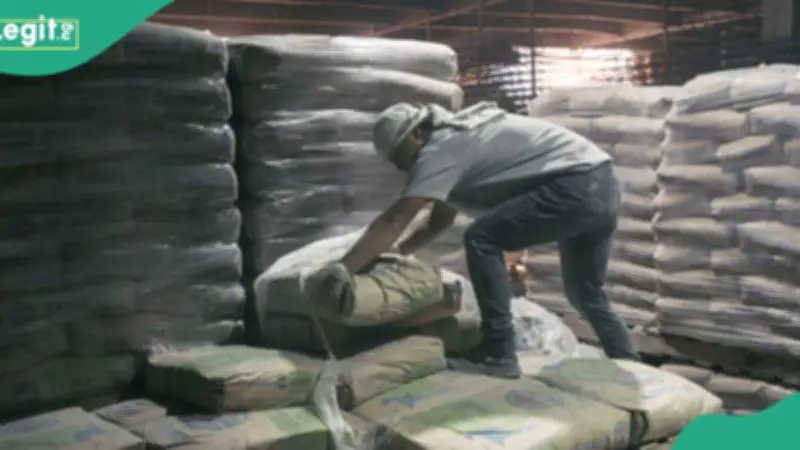
The Federal Competition and Consumer Protection Commission (FCCPC) has intensified its investigation into Nigeria's cement industry as the price of a 50kg bag climbs beyond ₦15,000 in some locations, raising fresh concerns about housing affordability and business costs. The regulator has issued formal Notices of Commencement of Investigation and Summons to Produce to major cement manufacturers, including Dangote Cement, BUA Cement, and HBM Nigeria (formerly Lafarge Africa).
The move follows a three-month cross-border assessment that raised preliminary concerns about possible price manipulation and other anti-competitive practices. The FCCPC stressed, however, that the investigation is still ongoing and has not established wrongdoing by the companies.
Why ₦15,000 Cement Is Raising Eyebrows
The sharp price movement has become harder to ignore because Nigeria has one of Africa's largest cement industries, with installed production capacity estimated at more than 60 million to 65 million metric tonnes annually. Domestic consumption, however, is estimated at only about 25 million to 30 million tonnes, meaning the country has substantial capacity beyond its estimated local demand. Nigeria is also a net exporter of cement to neighbouring countries.
For the FCCPC, that creates a critical question: why has excess capacity failed to translate into cheaper cement for Nigerian consumers? The commission's market intelligence showed that a 50kg bag sold for about ₦9,300 to ₦9,700 in January 2026. By mid-year, prices had risen to between ₦10,500 and ₦13,000, while some locations recorded ₦13,000 to ₦15,000 by July. More recent reports indicate that Dangote Cement has crossed ₦15,000 in some markets, adding fresh pressure on builders and prospective homeowners.
Nigeria Pays More Than Some African Markets
The FCCPC's cross-border comparison adds another layer to the controversy. In Nairobi, Kenya, the commission found a 50kg bag selling for about $5.40, equivalent to ₦7,344 using its conversion. Tanzania was placed at about $4.80 or ₦6,528, while Togo, which does not have significant limestone deposits, was reported at $6.75 or ₦9,180. Nigeria's higher prices are therefore difficult for the regulator to explain solely through raw-material availability.
The FCCPC is now demanding detailed information on pricing methodologies, production levels, capacity utilisation, exports, and commercial relationships. Industry participants have cited rising energy costs, naira depreciation, expensive imported machinery and spare parts, transportation, and logistics as factors pushing up prices. But the regulator wants to test those explanations against verified financial, production, and market data, according to a report by The Nation.
Housing Crisis Adds Pressure
For ordinary Nigerians, the debate is bigger than cement. Building-sector operators say erratic cement prices are already feeding into construction costs, property prices, and rents, potentially making home ownership even more difficult. They have urged the FCCPC to conclude its investigation and publish its findings while encouraging stronger competition and greater transparency in the market.
The FCCPC's next task is therefore clear: determine whether the price increases are justified by legitimate costs and market conditions or whether coordinated conduct, abuse of market power, supply restrictions, or other anti-competitive practices are involved. Until that answer emerges, one uncomfortable reality remains: Nigeria has the limestone, the factories, and the capacity, yet Nigerians are still paying a premium for cement, Leadership reports.
The FCCPC has opened a major investigation into Nigeria's cement industry, questioning why prices remain significantly higher than in several other African countries despite the country's huge limestone reserves and substantial production capacity. The commission has summoned major cement manufacturers, including leading industry players, as it examines whether the current price of cement is being driven by genuine production costs or possible anti-competitive practices.