The Central Bank of Nigeria has directed all banks, payment service banks and other financial institutions to immediately freeze the accounts and assets of ten individuals and entities designated for terrorism financing, following sanctions imposed by both the United States and Nigeria's own Sanctions Committee.
US sanctions trigger asset freeze
The directive, contained in a CBN circular dated June 24, follows the US Treasury's Office of Foreign Assets Control sanctioning a Lagos-based financier, Mukhtar Adamu Muhammad, 35, along with three Bureaux De Change accused of moving money for the Islamic State West Africa Province. US authorities allege the BDCs—Nine to Nine Exchange Bureau De Change, Manhattan Bureau De Change, and Generation Currency Bureau De Change—and Muhammad himself materially assisted, sponsored, or provided financial support to ISIS-West Africa.
The sanctions also extended beyond Nigeria, targeting a France-based individual accused of disseminating bomb-making instructions to ISIS affiliates, and a Syria-based operative accused of using cryptocurrency channels to move funds for ISIS associates internationally, including in the US.
Nigeria adds more names to sanctions list
Nigeria's response went further than simply acknowledging the US action. Days earlier, on June 18, the Nigeria Sanctions Committee added six more individuals and one company to its own sanctions list: Ibrahim Yakubu Ogirima, Adamu Chiroma, Ibrahim Abubakar, Abdullahi Umar Usman, Babangida Muhammed, Adamu Hammajam, and Abbal Bako & Sons Bureau De Change Limited. Combined with Muhammad and the three BDCs named by the US, that brings the total to ten people and entities now facing an asset freeze under Nigerian law.
Banks have been instructed to identify and freeze funds, assets and economic resources linked to designated individuals and companies.
Banks given 48 hours to comply
The CBN's circular instructed financial institutions to identify and immediately freeze all funds, assets and economic resources tied to the designated parties, without prior notice, and to ensure no funds or services are made available to them directly or indirectly. Banks have been given 48 hours to file compliance reports confirming whether any matching accounts were found, and how much, if anything, has been frozen. Institutions with no matches are still required to file mandatory "nil returns," and the CBN warned that submitting false or misleading information would itself constitute a regulatory violation.
Security and financial intelligence agencies are working with regulators on terrorism financing investigations. The apex bank also ordered banks to intensify monitoring for red flags like rapid movement of funds, use of informal money channels, and transactions tied to high-risk jurisdictions, and to retrospectively review past dealings with the designated individuals and entities.
Part of ongoing enforcement push
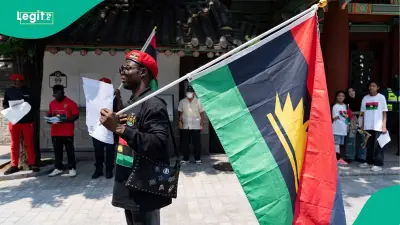
This isn't Nigeria's first such move this year. In April, the Nigeria Sanctions Committee, working with the Nigerian Financial Intelligence Unit, published a list of 48 individuals and organisations linked to terrorism financing, ordering an immediate freeze on their accounts as well. That list named people connected to proscribed groups including IPOB, Ansaru and ISWAP. The latest action effectively folds the new US-flagged names into that same ongoing enforcement push.
Nigerian authorities have framed the latest freeze as proof of deepening cooperation with Washington on counterterrorism financing. A statement from the Sanctions Committee said the country remains "resolute in its commitment to ensuring that terrorists and their financiers find no safe haven within the country's financial system," while crediting the CBN, the Department of State Services, the EFCC and the Nigerian Financial Intelligence Unit for supporting the effort.