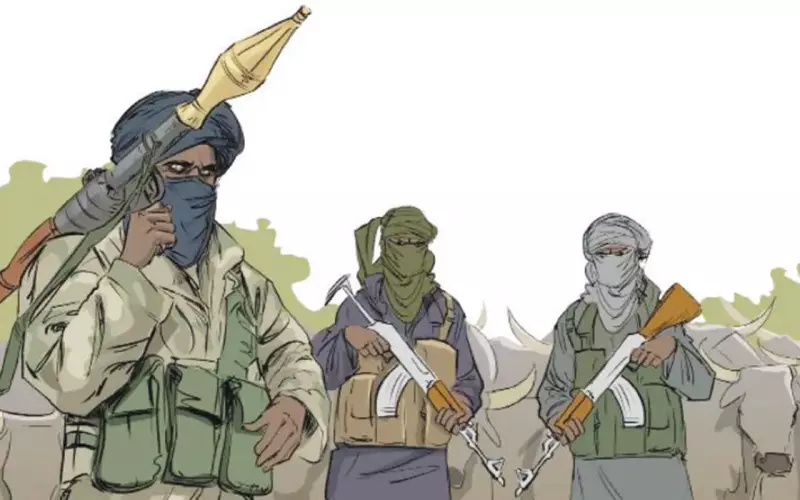
The security situation in Nigeria has reached a critical juncture, with recent comments from United States President Donald J. Trump sending shockwaves through the political landscape. President Trump announced his readiness to send American military forces "guns ablazing" to target Islamic jihadists he accused of killing Christians in Nigeria. This statement has stirred significant controversy and heightened tensions around the nation's protracted security crisis.
A Capital Under Siege and a Relentless Wave of Abductions
In a alarming development, the safety of Abuja, Nigeria's federal capital territory, is now in serious question. The deteriorating security environment over the past month has become so dire that lawmakers based in the capital are being compelled to actively assist President Bola Tinubu in searching for solutions.
This scramble for answers comes even as the administration attempts to highlight minor victories. While security agencies celebrated the recovery of 24 schoolgirls abducted in Kebbi State and 38 church worshippers kidnapped in Kwara State on Sunday, November 23, a far grimmer picture persists. Security forces are still struggling to secure the release of over 300 girls abducted from a school hostel in Niger State.
Meanwhile, multiple kidnappings continue unabated across the northern and middle belt states. A disturbing pattern has emerged where scarcely a Sunday passes without an incident involving the kidnapping or attempted kidnapping of innocent Nigerians, particularly churchgoers. Criminals appear to have identified soft targets: school children, worshippers, and travelers, where large numbers of people can be seized in a single, devastating operation.
A 23-Year-Old Prescription: Deregulating the Security Architecture
Given the escalating cycle of violence, public policy analyst Magnus Onyibe has revisited a radical solution he first proposed 23 years ago during President Olusegun Obasanjo's administration: the deregulation and decentralization of the Nigerian police force.
In his original article from January 15, 2002, Onyibe argued that even then, the Nigerian Police was overwhelmed. He pointed to the assassination of Chief Bola Ige, the nation's Attorney General and Justice Minister, as a prime example of sophisticated crime that a poorly equipped and monolithic security system could not handle. He lamented that the police were using "primordial methods and tools" to fight modern crime.
The core of his argument is that the problem is not solely a lack of personnel or funding—though those are issues—but a fundamental structural flaw. He draws parallels to other sectors transformed by deregulation, such as telecommunications, where the licensing of GSM providers revolutionized the industry. Similarly, he cites improvements in banking, aviation, and broadcasting as fruits of the Structural Adjustment Programme (SAP) of the 1980s.
"Why shouldn't the Nigerian security system as typified by the Nigerian Police which has been generally acknowledged as inefficient and ineffective also receive the deregulation therapy?" Onyibe asked over two decades ago—a question that remains painfully relevant today.
A Glimmer of Hope in a State of Emergency?
There is a cautious sense of anticipation that President Bola Tinubu could be the leader to finally break the jinx of insecurity. This hope is pinned on his policy pronouncements, including the declaration of a national state of emergency on insecurity. If followed through with decisive action, these measures could mark a turning point.
The convergence of international attention, domestic pressure from the National Assembly, and a seemingly relentless assault on citizens has created a moment of reckoning. The proposal to deregulate security, once considered naive, is gaining renewed attention as a potential blueprint for a system that has failed to evolve with the growing sophistication of criminal elements.
The nation now watches to see if President Tinubu's administration will pursue not only immediate tactical responses but also the kind of deep, institutional reform suggested 23 years ago. The security of millions of Nigerians depends on whether this historical cycle of violence can finally be broken.