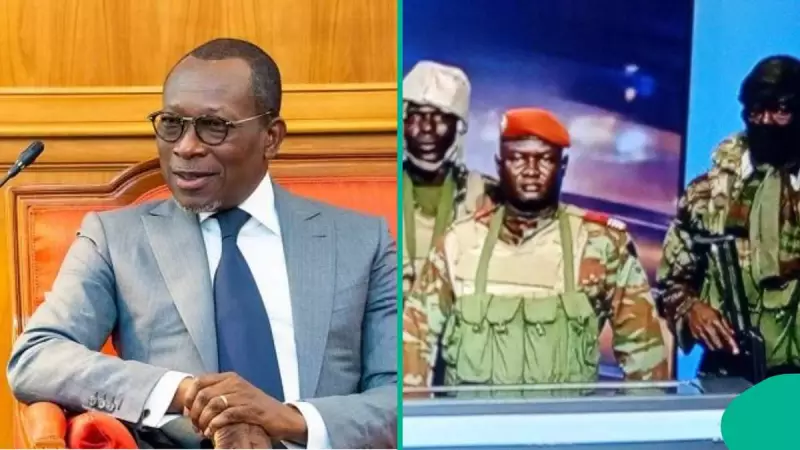
In a dramatic turn of events that has sent shockwaves across West Africa, military personnel in the Republic of Benin announced on Sunday, December 7, 2025, that they had removed President Patrice Talon from power. The announcement was broadcast on state television by a faction identifying itself as the "Military Committee for Refoundation" (CMR).
Presidency Breaks Silence, Confirms Talon's Safety
Despite the bold declaration from the soldiers, the Benin presidency has broken its silence, offering a starkly different narrative. Sources close to President Talon have insisted that the 67-year-old leader is safe and secure. One authoritative source described the event as the action of "a small group of people who only control the television."
The same sources confirmed that the regular army is actively regaining control of the situation. They assured the public that the economic capital, Cotonou, and the country at large are "completely secure." The clean-up operation is reportedly progressing well, with the expectation that normalcy will be restored shortly.
A separate military source corroborated this, stating the situation was "under control" and revealing that the coup plotters had failed to seize key locations, including the presidential residence and offices.
Gunfire and International Reaction
The incident was preceded by reports of gunfire near the president's official residence. The French Embassy in Benin took to social media platform X to alert its citizens, noting that "gunfire was reported at Camp Guezo" in Cotonou. The embassy issued a safety advisory, urging French nationals to remain indoors.
The soldiers' televised broadcast, in which they stated they had "met and decided that 'Mr Patrice Talon is removed from office as president of the republic,'" was abruptly cut off, signaling the beginning of the counter-operation by loyalist forces.
Political Context and Regional Instability
This attempted coup unfolds against a complex political backdrop. Patrice Talon, a former businessman often called the "cotton king of Cotonou," first came to power in 2016. He is currently serving his second and final term, which is constitutionally mandated to end in 2026, with a handover expected in April of that year.
His tenure has been a paradox of strong economic growth juxtaposed with accusations of authoritarianism and rising jihadist violence in the region. Critics point to the exclusion of the main opposition party from the upcoming succession race as a sign of democratic backsliding.
Most significantly, Benin's latest crisis mirrors a disturbing regional trend. This event places Benin on a growing list of West African nations grappling with military interventions, following recent takeovers in Niger, Burkina Faso, Mali, Guinea, and Guinea-Bissau. The stability of the entire region remains under severe threat as these events continue to unfold.