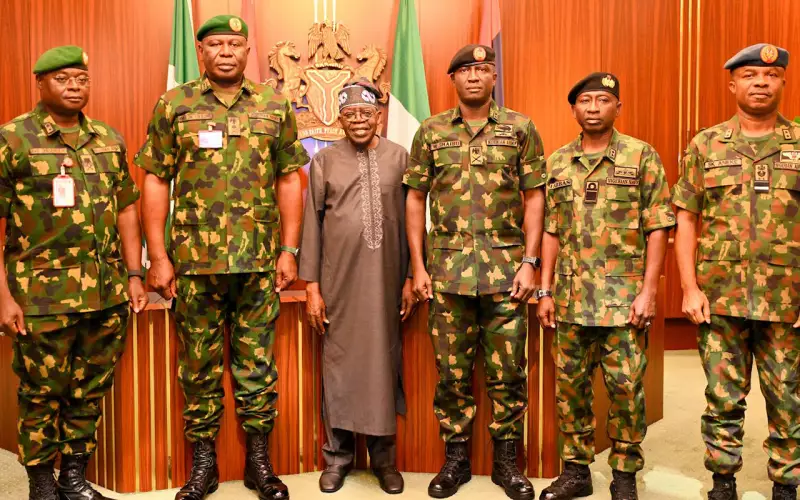
President Bola Tinubu has taken a decisive step in asserting his administration's approach to the nation's pressing security challenges by convening his first formal meeting with the country's top military commanders. The high-level security engagement, held behind closed doors at the Presidential Villa in Abuja, signals the beginning of a strategic realignment under the newly appointed Minister of Defence.
A Strategic Meeting Amid Mounting Pressures
The meeting, which commenced at approximately 6:01 pm on Monday, December 15, 2025, followed President Tinubu's attendance at the public presentation of a book titled From Soldier to Statesman: The Legacy of Muhammadu Buhari. This gathering is particularly significant as it marks the President's first direct engagement with the military high command since the swearing-in of General Christopher Musa (ret) as the Minister of Defence on December 4.
Officials present at the Villa described the session as a critical security engagement, reflecting the government's urgency in confronting both national and regional concerns. The closed-door nature of the talks meant that journalists were not briefed immediately afterward, leaving the specific outcomes and directives to speculation among analysts and security observers.
The Backdrop of Insecurity and Regional Duty
The President's meeting with the Service Chiefs occurs against a grim backdrop of unrelenting internal security threats. A primary concern is the continued captivity of 115 students abducted from a Catholic boarding school in November. This incident has intensified public outcry and pressure on the Federal Government to overhaul its strategy for combating kidnapping and mass abductions, especially in the northern regions and parts of the Middle Belt.
In response to the deteriorating situation, President Tinubu had earlier, on November 26, declared a national security emergency. Key directives from that declaration included:
- The recruitment of new personnel into security agencies to address critical manpower shortages.
- The withdrawal of police officers attached to private individuals and VIPs for redeployment to active, frontline policing duties.
Furthermore, Nigeria's security responsibilities are expanding beyond its borders. The meeting came just days after the Senate approved Tinubu's request to deploy Nigerian troops to the Republic of Benin following an attempted coup in the neighbouring West African nation. This move underscores Nigeria's leading role in regional stability under ECOWAS security frameworks.
Broad Agenda and Leadership Reassessment
While the official agenda was not disclosed, security sources indicate the discussions covered a wide spectrum of issues crucial to national safety. The expected topics included:
- Internal security operations and counterterrorism efforts.
- Enhancement of intelligence coordination among agencies.
- Strengthening border security.
- Fulfilling Nigeria's regional security commitments.
The timing of this engagement is seen by political and security analysts as a clear signal from President Tinubu. It demonstrates a hands-on effort to assert civilian authority over security policy, improve coordination across the army, navy, and air force, and ultimately, restore eroding public confidence in the state's ability to safeguard lives and property.
This meeting also arrives amidst renewed calls from various quarters for a review of the defence establishment's performance. There is growing pressure on the President to assess the effectiveness of senior security officials given the persistence of violent incidents across the country. Although the Presidency has remained silent on these speculations, the direct dialogue with the Service Chiefs is interpreted as the first step in a comprehensive reassessment of Nigeria's security architecture under the new ministerial leadership.