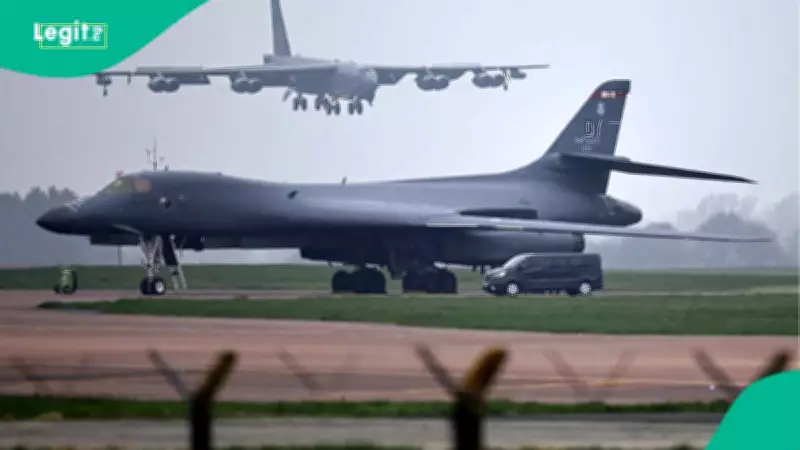
US Military Refueling Aircraft Crashes in Western Iraq During Ongoing Conflict
A United States Air Force KC-135 Stratotanker, a critical aerial refueling aircraft, crashed in western Iraq on Thursday during Operation Epic Fury, the Pentagon's designation for military operations against Iran. The US Central Command (CENTCOM) has confirmed the incident, stating that rescue efforts are actively underway to locate and assist the crew members who were aboard the aircraft when it went down.
Details of the Crash and Ongoing Rescue Mission
According to official statements from CENTCOM, the crash occurred in what is described as friendly airspace. A second US tanker aircraft was involved in the same operation but managed to land safely at its destination. Military officials have explicitly ruled out hostile fire or friendly fire as the cause of this tragic incident, though the exact reason remains under investigation. At least five crew members were reportedly on board the KC-135 Stratotanker at the time of the crash, according to information provided by a US official to CNN.
The US Central Command emphasized: "The incident occurred in friendly airspace during Operation Epic Fury, and rescue efforts are ongoing. Two aircraft were involved in the incident. One of the aircraft went down in western Iraq, and the second landed safely. This was not due to hostile fire or friendly fire." CENTCOM has requested patience from the public and media as details are gathered to provide accurate information, particularly for the families of the service members involved.
Strategic Context and Location of the Incident
Western Iraq, where the crash took place, is a sparsely populated desert region. While US and allied forces in Iraq have frequently faced attacks from pro-Iran militias, these assaults typically involve drone strikes and are more common in the northern parts of the country. The area's remote nature may complicate rescue and recovery operations, but it also reduces immediate risks to civilian populations.
Role and History of the KC-135 Stratotanker
The KC-135 Stratotanker serves as a flying fuel station for the US Air Force, enabling other aircraft to refuel mid-air and significantly extend their operational range during missions. A standard crew configuration includes a pilot, copilot, and a boom operator, with navigators sometimes added for specific assignments. The aircraft can also be adapted to transport cargo or medical patients when necessary.
Notably, the KC-135 fleet is among the oldest in the US Air Force inventory, with the last unit delivered back in 1965. Based on the Boeing 707 passenger jet design, approximately 376 units were reported active as of last year. Despite undergoing various upgrades over the decades, including the installation of new engines, the aircraft remains a legacy platform with inherent age-related challenges.
Recent US Aircraft Losses in the Conflict with Iran
This crash represents the fourth known loss of a US aircraft in the ongoing war with Iran. Just last week, a friendly fire incident over Kuwait resulted in three F-15E Strike Eagle fighter jets being shot down. Fortunately, all six crew members in that incident were able to eject safely and survived. The pattern of aircraft losses highlights the intense operational tempo and risks associated with military engagements in the region.
Broader Regional Tensions and Accusations
In related developments, the Israeli Ministry of Foreign Affairs has recently accused Iran of targeting civilians with cluster munitions. These controversial weapons release multiple smaller explosives over a wide area, posing significant risks to civilian populations both during and after attacks due to unexploded bomblets. International organizations have repeatedly expressed concerns about the humanitarian impact of such munitions, adding another layer of complexity to the regional conflict dynamics.
The crash of the KC-135 Stratotanker underscores the ongoing challenges and dangers faced by US military personnel in the Middle East, particularly as operations against Iran continue under Operation Epic Fury. As rescue teams work diligently in western Iraq, the incident serves as a sobering reminder of the human cost of military engagements, even when not directly caused by enemy action.