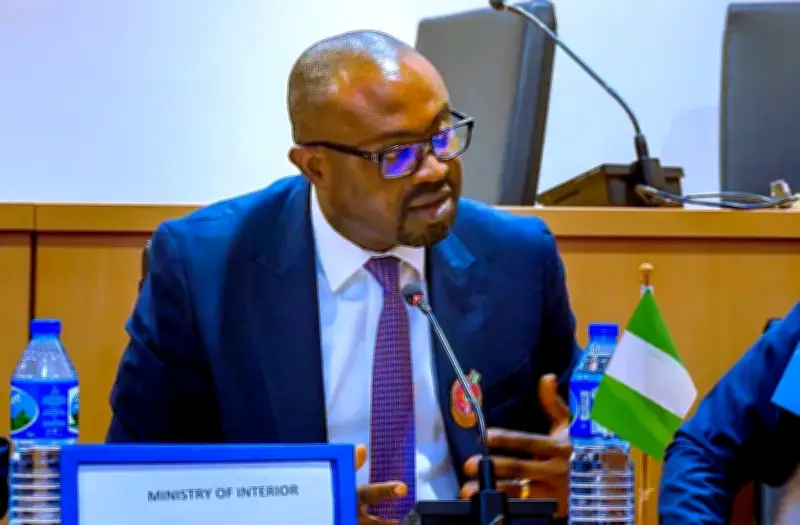
Nigeria's Minister of Interior, Dr. Olubunmi Tunji-Ojo, has disclosed that 93 percent of inmates in Nigerian correctional centres are state offenders, with only 7 percent held for federal offences. Speaking at the Regional Conference on the Classification of Prisoners and the Use of Technology in Prisons in Africa, jointly organized by the United Nations Office on Drugs and Crime and the African Correctional Services Association, Tunji-Ojo noted that a significant proportion of these inmates do not require incarceration.
Minor Offences and Overcrowding
“93% of our inmates in Nigeria are state offenders. Only 7% are federal offenders. And of this 93%, I want to tell you before this president came on board, a lot of them were for minor offences that had no need for incarceration,” the minister said. He recounted ordering an audit of inmates held over minor fines and compensation judgments soon after assuming office. “When I became minister, I called my permanent secretary, I called the Controller General of the Correctional Service, and I said, listen, give me the data, the record of people who are in correctional centres for fines and compensation of less than 500,000 or something. And guess what? Over 4,000 people,” he said.
Financial and Social Impact
According to Tunji-Ojo, the exercise exposed the futility of keeping such offenders in custody at public expense. “I said, what is the sense in this? Because I feed them in a year with more than 10 times of the fine. So how is the government benefiting? And we were able to clear that, and in one day, we decongested our correctional centre by 5% in one day. In one day,” he said. The minister stressed that correctional authorities across Africa must confront whether their facilities are rightfully overcrowded. “The question is this. Is your correctional centre rightfully overcrowded? That is the question. You have to look at those particular offences. You will realise that more than 30, 40, 50 percent are offences that do not warrant incarceration,” he added.
Recidivism and Rehabilitation
Tunji-Ojo also disclosed that recidivism in Nigeria’s correctional centres had fallen sharply under the current administration, from about 13,000 cases annually in 2023 to 1,000 last year. He attributed this decline to expanded access to education and vocational training for inmates. The correctional service currently has 62 inmates pursuing postgraduate studies, 261 in undergraduate programmes, 1,125 in formal education, 18 National Open University centres domiciled in correctional facilities, and 9,582 inmates enrolled in vocational and non-formal rehabilitation programmes.
Enhanced Security and Technology
Nigeria has gone three years without recording a single jailbreak or attack on a correctional facility, a feat linked to improved data management and inter-agency information sharing. Tunji-Ojo cited an incident where an escaped inmate was rearrested after attempting to obtain a Nigerian passport using biometric data linked across security agencies. “Immediately he put his finger at the level of Nigeria immigration service to procure a passport. Immigration saw it immediately that he was an inmate. And immediately they reached out to correctional service and he was arrested right there,” he said.
Modernisation and Collaboration
The Controller General of the Nigerian Correctional Service, Sylvester Ndidi Nwakuche, said Nigeria has continued to modernise its correctional system through reforms anchored on the Nigerian Correctional Service Act, 2019. He noted that effective prisoner classification has become a strategic tool for identifying inmates’ risks, protecting vulnerable prisoners, deploying resources efficiently, and delivering targeted rehabilitation programmes. Nwakuche added that integrating technology into correctional administration would enhance record management, improve information sharing, and strengthen institutional accountability. “We have a unique opportunity to exchange ideas, share practical experiences and collectively develop solutions that will strengthen correctional systems across Africa,” he said.