Nigeria's Director of Defence Information, Samalia Uba, has contradicted a claim by a top US official that American forces seized a large cache of electronic materials from terrorists in Nigeria. Uba told PREMIUM TIMES that the materials were voluntarily released to the US by the Nigerian government as part of ongoing security cooperation.
Voluntary Release of Intelligence Materials
Uba said the materials, which contained declassified information on previous counter-terrorism operations by the Nigerian Armed Forces, were voluntarily 'given' to the US. This is the first comment by a Nigerian official on the matter since a US official first announced it.
The US Deputy Assistant to the President and Senior Director for Counterterrorism at the National Security Council, Sebastian Gorka, disclosed in late June that American forces had recovered a large cache of electronic materials from terrorists in Nigeria. Gorka said US soldiers seized the materials during an operation that resulted in the killing of 199 jihadists.
US Official's Claims
'I watched our operators kill 199 jihadis in one operation, and seized an unprecedented volume of intelligence materials,' Gorka said. He described the materials seized as the largest since the 11 September 2001 attack, a significant event in US history. 'From that raid, we needed an extra plane to bring home all the electronic material that we captured in those camps. The haul was three times bigger than any enemy electronics haul since 9/11,' he said.
Although Gorka did not identify the military operation by name, his description corresponds with the joint Nigeria-United States raid announced in May, which eliminated Abu-Bilal al-Minuki, also known as Abubakar Mainok, a top commander of Islamic State West Africa Province (ISWAP).
Nigeria's Response
When asked why the Nigerian government had not publicly disclosed the release of the materials, Uba said it was part of the country's joint counter-terrorism cooperation, which 'has been extensively publicised.' 'It is not a new operation,' he said. 'We have previously communicated our highly successful joint operations in May. Nigeria-US joint operations and collaboration are very much on course.'
Kimiebi Ebienfa, the spokesperson of the Ministry of Foreign Affairs, also told PREMIUM TIMES that the materials were provided to give the US a clearer picture of terrorist operations in the country. 'I don't think it is an indictment that we shared this information with them,' he said. 'Sharing intelligence is part of the counter-terrorism cooperation Nigeria has with the US.' 'We share intelligence with them. Especially with the arrival of their troops on our soil to help combat terrorist attacks,' he noted.
Sanctions and Reactions
Six weeks after the operation, the US accused and sanctioned Mukhtar Adamu, a Lagos-based bureau de change operator, of facilitating financial transactions for the West African faction of ISIS through his BDC firms. The named firms that were also sanctioned are: Nine To Nine Exchange Bureau De Change Limited, Generation Currency Bureau De Change Limited, and Manhattan Bureau De Change Limited. After the US announcement, Nigeria also sanctioned Adamu and his companies.
Christian Genocide Allegations
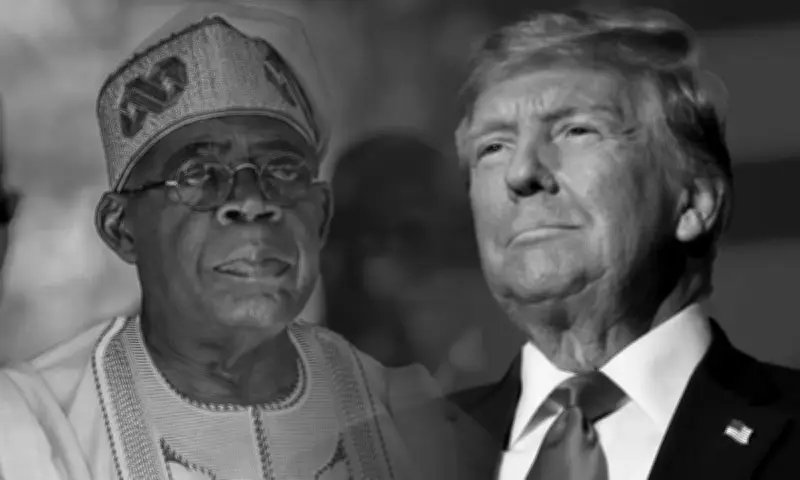
The US-Nigeria counter-terrorism operations came after months of US antagonism and hostility toward Nigeria over alleged Christian genocide. The narrative was initially pushed by American commentators and top political officials such as Ted Cruz, Riley Moore, and Chris Smith before eventually drawing President Donald Trump's attention. PREMIUM TIMES reported that Moore, a US congressman, had described Nigeria as the most dangerous country to be a Christian. In late 2025, Trump designated Nigeria a Country of Particular Concern and subsequently imposed a visa ban.
Last Christmas, the US launched air strikes in Sokoto targeting what it described as Islamic State terrorists. Trump called the strikes a 'Christmas present' to vulnerable Christian communities. But Sokoto is an overwhelmingly Muslim-majority state, as are the casualties of violent attacks carried out by armed groups operating in the state.
The US also sanctioned groups and individuals considered to be associated with terror groups in Nigeria. A bill seeking to impose sanctions on the Miyetti Allah Cattle Breeders Association of Nigeria (MACBAN) and the Miyetti Allah Kautal Hore was presented before the congress last year. It accused the organisations of masterminding some attacks by armed herders on rural communities.
In February, the US froze the assets of eight Nigerians allegedly linked to terrorist organisations. Weeks later, Nigeria then published the names of 48 persons and 12 organisations linked to terror financing. Last month, Nigeria also sanctioned Adamu, along with five other individuals, after a US government announcement. The others named by the Nigerian government are: Ibrahim Yakubu Ogirima, Adamu Chiroma, Ibrahim Abubakar, Abdullahi Umar Usman and Babangida Muhammed Adamu Hammajam.