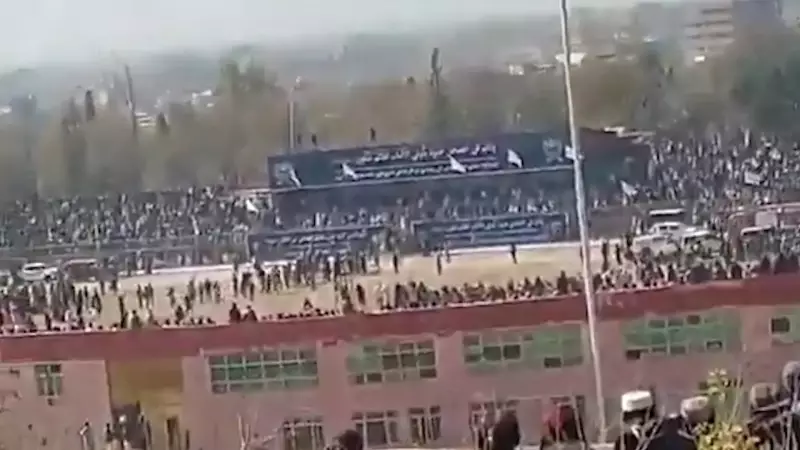
A chilling public execution carried out by a 13-year-old boy has drawn global attention and condemnation, marking a stark return to the Taliban's harsh interpretation of Islamic law. The event saw the teenager shoot dead a man convicted of murdering nearly his entire family, in front of a massive crowd at a sports stadium.
Stadium of 80,000 Witnesses Retributive Justice
The execution took place in Khost province before an estimated 80,000 spectators who packed a cricket stadium. According to the Taliban-run Supreme Court, the executed man, along with an accomplice, was found guilty of a horrific crime: breaking into a family home and murdering 13 people. The victims included nine children and their mother.
Under the Taliban's application of qisas, or retributive justice, the surviving relatives of the victims were given the choice to pardon the killer. They refused, demanding the death penalty instead. The court approved the execution after all judicial levels, including the Taliban's supreme leader, gave their final authorization.
A Grim Spectacle and Mixed Reactions
The boy fired three shots into the condemned man as sections of the crowd shouted "Allahu Akbar." Taliban authorities attempted to control the narrative by banning camera phones from the stadium, but images later surfaced showing huge crowds lining up to enter. Mujib Rahman Rahmani, a resident who attended, defended the act, suggesting such public punishments could deter future crimes. "No one will dare to kill anyone in the future," he said.
This event is at least the 11th public execution since the Taliban regained power in 2021. Their return has seen the reinstatement of strict Sharia punishments, alongside severe restrictions on women's rights to education and work.
International Condemnation and a Dark History
The execution prompted immediate international outcry. United Nations Special Rapporteur for Afghanistan Richard Bennett took to social media platform X to call for a halt to the execution before it occurred, labeling public executions as "inhumane" and "contrary to international law." His appeals were ignored.
The spectacle is a grim echo of the Taliban's previous rule in the late 1990s, when public executions, amputations, and floggings were commonplace. While corporal punishment, mainly floggings, has become routine again, this high-profile execution has sharply refocused global scrutiny on the regime's human rights record.
Despite the condemnation, the execution proceeded as planned, transforming a sports ground into a site of judicial killing, witnessed by tens of thousands who traveled to see it, cementing the Taliban's hardline approach to justice.