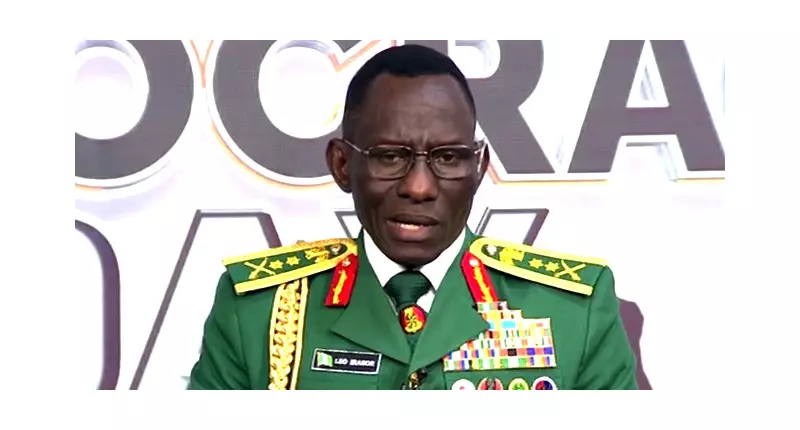
Nigeria's former top military officer, General Lucky Irabor, has made a stunning allegation, stating that certain politicians within the country are actively exploiting and even bankrolling insecurity to achieve their political objectives.
A Stark Warning from a Former Defence Chief
General Irabor, who recently retired as the Chief of Defence Staff, issued this grave warning during a televised interview on Channels Television on Monday, December 1. He strongly cautioned the public and analysts against making broad, simplistic statements about the nation's protracted security challenges.
The retired general emphasized that Nigeria's security threats are multifaceted and cannot be pinned on a single cause. His analysis points to a dangerous mix of ideological, criminal, political, and economic drivers fueling violence across various regions.
Unpacking the Layers of Criminality
Irabor provided a detailed breakdown of the different actors contributing to the crisis. He explained that violent groups operate with diverse and often overlapping motives, which complicates any unified response.
"If you lump the entire thing into one, the analysis would be wrong," Irabor stated. He listed the distinct categories of perpetrators:
- Ideological terrorists with a defined belief system.
- Those specifically targeting Christian communities.
- Actors aiming to displace communities to occupy their land and gain political influence.
- Purely economic criminals and bandits.
This complex landscape, according to him, makes the security situation exceptionally difficult to untangle and resolve.
The Damning Political Connection
While refuting the idea that insecurity is solely a political creation, General Irabor conceded that political motives form a deeply troubling part of the equation. He admitted that some political figures have weaponized the climate of fear for personal advancement.
"That does not mean some politicians have not taken advantage of the insecurity to perhaps gain some sort of leverage; to give the impression that they can do better," he revealed.
He went further, suggesting other political motives: "Others perhaps want to score a point that there’s poor governance; they could also instigate crisis in one way or the other." This admission points to a cynical manipulation of violence for electoral or rhetorical advantage.
General Irabor's explosive comments come barely 24 hours after a presidential aide announced that the Federal Government is set to publicly name individuals suspected of financing terrorism activities in Nigeria.
Together, these developments underscore the intensely complicated nature of the security challenges confronting the Nigerian state. They highlight the intersection of crime, ideology, and politics, suggesting that a solution requires addressing not just the violence itself, but also the hidden networks and incentives that allow it to persist.