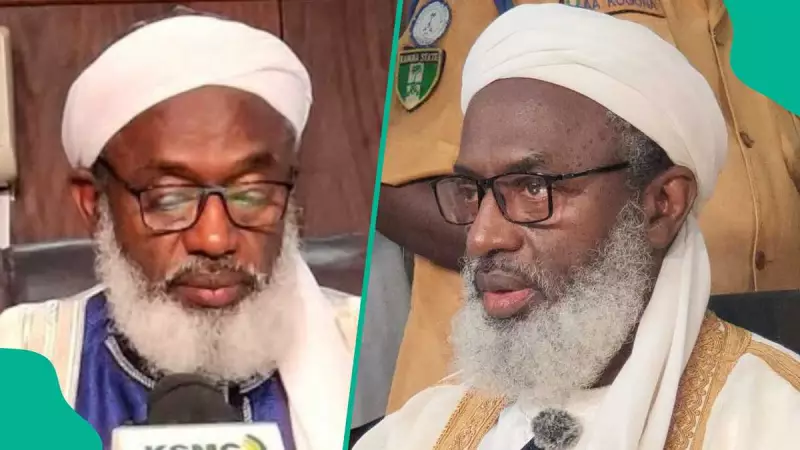
Prominent Nigerian Islamic scholar, Sheikh Ahmad Mahmud Abubakar Gumi, has made a significant claim that wealthy foreign actors are allegedly providing support to terrorists and bandits operating within Nigeria. This assertion points to international involvement as a key factor in the country's persistent and recently escalating security crisis.
Foreign Interference and the Roots of Insecurity
In a detailed interview with the BBC Hausa service, Sheikh Gumi pointed to the deteriorating security situation in several regions as potential evidence of this external backing. He specifically stated that "powerful, wealthy foreigners" are able to interfere in the affairs of nations, a topic he claims is widely discussed on the global stage. While acknowledging some improvements in areas like the Abuja-Kaduna highway, Gumi noted a worrying resurgence of violence and attacks.
The cleric argued that the crisis is compounded by internal issues, primarily corruption and complicity within the Nigerian system. He dismissed any attempts to explain away the reality of corruption, framing it as a fundamental enabler of the ongoing conflict. Gumi emphasized that unless the underlying causes of the unrest are properly addressed, the cycle of violence will continue unabated.
On Peace, Force, and Reconciliation
Commenting on the stance of Nigeria's new Minister of Defence, retired General CG Musa, who declared that there is no peace with bandits, Sheikh Gumi agreed with the necessity of military force. He clarified that "peace is not possible without force" where necessary, indicating that the military should not be lenient in its operations. However, he was keen to distinguish this from his own efforts at dialogue.
Gumi stressed that his initiatives to engage with bandits are motivated by religious principles and a genuine desire for societal peace, not support for criminality. He explained that his approach involves telling the bandits that their actions, such as kidnapping and seizing property, are haram (forbidden in Islam). He suggested that with government support, such dialogue could have concluded this troubling chapter.
Gumi's Stance on Nnamdi Kanu and Historical Precedents for Pardon
The scholar also addressed the case of Nnamdi Kanu, the leader of the proscribed Indigenous People of Biafra (IPOB), who was sentenced to life imprisonment on terrorism charges in November 2025. Gumi revealed that his offer of forgiveness to Kanu is driven by the same desire for peace that guides his outreach to bandits.
He outlined conditions for this forgiveness, stating that if Kanu shows remorse, repents for his actions, and orders his followers to lay down their weapons, he would advocate for clemency. Gumi cited historical precedents to support this approach, recalling how President Shehu Shagari pardoned Chukwuemeka Ojukwu after the Civil War and how President Umaru Musa Yar'Adua granted amnesty to militants in the Niger Delta region.
Gumi concluded by reiterating the core principle guiding his advocacy: "We always ask for forgiveness because forgiveness reduces the suffering of other people." His comments present a complex view of Nigeria's security challenges, blending allegations of foreign interference with calls for strategic force and religiously-informed reconciliation.