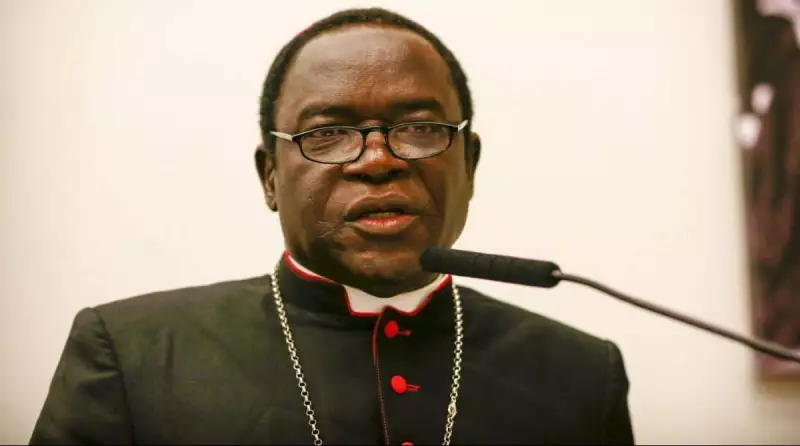
Bishop Matthew Hassan Kukah of the Sokoto Diocese has issued a strong warning against the rising calls for communities to arm themselves against terrorists and bandits. He described this approach as providing only a false sense of security that fails to address the root causes of Nigeria's instability.
A Warning Against Weapons
The Bishop delivered his message on Thursday in Abuja at a significant national dialogue. The event, focused on a whole-of-society approach to preventing violence in Northern Nigeria, was hosted by the National Peace Committee, the Kukah Centre, and the Office of the National Security Adviser.
Kukah directly challenged the logic of distributing arms to civilians. He posed a critical long-term question: "What would happen to those arms if peace were eventually restored?" He argued that weapons are not a solution, stating, "Arms will not solve our problems. They offer a false sense of security."
Root Causes: Broken Homes and Fractured Society
The cleric insisted that the nation's security crisis stems from deeper social and moral decay. He pointed to broken homes, fragmented communities, and weakened moral foundations as the fertile ground where bandits and criminals thrive. For Kukah, these underlying vulnerabilities must be confronted for any lasting peace to be achieved.
"The scale and depth of the insecurity problem in the country show that we have hit rock bottom, and the only direction left is upwards," he declared, emphasizing the urgency of the situation.
The Path Forward: Unity and Collective Action
Bishop Kukah's prescription for peace involves a fundamental shift in approach. He called for unity across faith, ethnic, and cultural lines, urging citizens to commit collectively to shared challenges. He framed the Abuja dialogue as part of a long journey, where participants must act as "custodians of conscience and hope."
"We meet because we believe Nigeria is worth fighting for, not with weapons, but with truth, courage, justice, and compassion," he told the gathering. He stressed that nation-building requires harmonising the country's extraordinary diversity, turning it from a potential liability into a powerful asset, much like the United States has done.
Kukah also made it clear that peace cannot be outsourced to the government or security forces alone. "Peace is the collective work of all of us," he asserted, outlining a model where every segment of society plays a role. This includes:
- Government leading with humility, transparency, and justice.
- Religious and traditional leaders showing courage in confronting extremism within their circles.
- Individuals and families seeking peace in their immediate environments.
He particularly highlighted the need for inclusive representation, noting that "women make up the majority of our population, yet many lack a voice... because voice means participation and representation." Building trust and speaking for the voiceless, Kukah concluded, are essential steps on the difficult road to securing Nigeria.