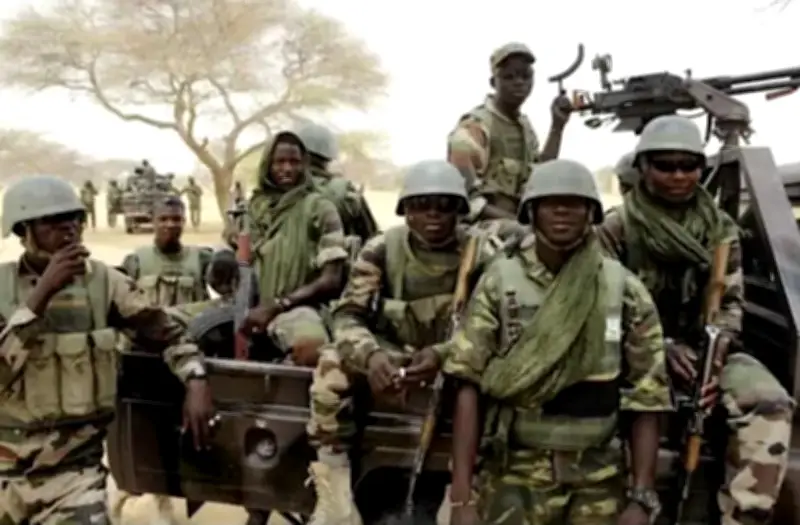
The Nigerian military has disclosed that a preliminary forensic analysis identified three foreign terrorist facilitators, including a Palestinian and a Moroccan, as key figures behind a failed attack by Islamic State West Africa Province (ISWAP) fighters on troops in Borno State.
Forensic analysis reveals foreign links
Mohammed Goni, the acting spokesperson for Operation Hadin Kai, a joint task force in the North-east, said the identification followed an attempted infiltration of troops’ position at Cross Kauwa in Kukawa Local Government Area on Saturday night. Soldiers repelled the attack after a fierce gun battle.
Forensic examination of a Sony camcorder recovered from a slain terrorist cameraman revealed that the failed operation was coordinated by four senior ISWAP commanders working alongside three foreign terrorist facilitators, according to Goni, a Nigerian Army captain.
Identified foreign operatives
The foreign operatives include a Palestinian identified as Abu Ishaq, believed to serve as ISWAP’s overall trainer; a Moroccan identified as Abu Thaiba, described as a medical doctor embedded within the terrorist network; and another Arab operative whose identity has yet to be established.
Goni said the findings reinforce intelligence assessments that ISWAP continues to receive external support, specialist expertise, and transnational terrorist backing despite sustained counter-insurgency operations in the North-east.
Background of ISWAP threat
In May, a joint operation involving Nigerian and United States troops targeted a terrorist enclave in the Lake Chad basin, killing scores of ISWAP fighters, including a commander, Abubakar Mainok. Despite that offensive, which authorities said had degraded ISWAP’s operational capabilities, the terror group continues to pose a threat.
Details of the Saturday attack
Goni said the attack occurred at about 10:20 p.m. on 11 July when the terrorists attempted to exploit darkness to breach the troops’ location. Troops detected the movement early and responded with coordinated firepower, forcing the attackers to retreat after suffering heavy casualties.
The military spokesperson said intelligence suggests the insurgents intended to loot cholera medical supplies. “The attempted looting further lends credence to recent intelligence reports of a cholera outbreak within terrorist enclaves, as well as reports of the execution of some affected members by the group,” he stated.
Recovered equipment and casualties
Following the gunfight, troops conducted exploitation operations and recovered the Sony camcorder, terrorist uniforms, several rounds of PKT and 7.62 mm Special ammunition, and other combat equipment. Satellite imagery obtained after the firefight showed terrorists evacuating the bodies of some of their fighters during the withdrawal, corroborated by human intelligence sources indicating significant casualties.
Two soldiers were wounded during the exchange and were evacuated by air for advanced medical treatment. Goni said both personnel remain in stable condition. He described the failed assault as another major setback for ISWAP, reflecting increasing pressure on the group and growing difficulty in carrying out coordinated attacks against military formations.