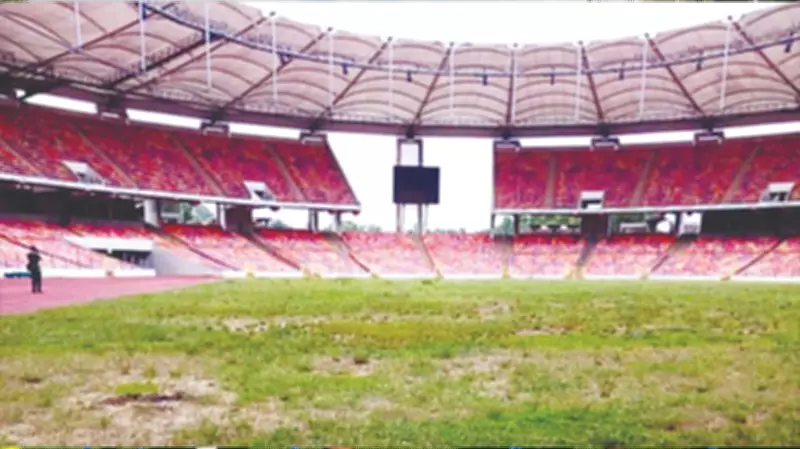
Nigeria's Football Crisis: How Dearth of Standard Pitches Hobbles the National Game
Despite boasting over 50 stadiums across the country, Nigeria currently has only two facilities with manageable playing pitches that meet the stringent requirements to host FIFA and CAF matches. This alarming situation has significantly contributed to the poor state of the nation's football, undermining player safety, performance, and overall development. A comprehensive report highlights that several critical factors bequeathing the country with substandard surfaces must be addressed urgently to reverse this trend.
The Critical Role of Quality Pitches in Football Development
Nations with a robust football culture prioritize high-quality playing pitches due to their substantial advantages. These facilities are essential for player safety and performance, offering benefits such as reduced injury rates and enhanced technical execution. Modern surfaces, including 3G and 4G systems with shock absorption, minimize risks associated with uneven terrain, mud, or frozen ground by providing better cushioning for joints and muscles.
Moreover, a flat and consistent surface enables:
- Smoother ball roll and predictable bounces
- A quicker, more fluid high-tempo game
- Players to showcase their technique effectively
For young athletes, quality pitches are indispensable for skill development, allowing practice on reliable surfaces without adapting to irregularities. Hybrid systems with excellent drainage also ensure play continues after heavy rainfall, reducing match cancellations.
Nigeria's Stadium Infrastructure: A Bleak Reality
In Nigeria, football stakeholders widely believe that the lack of quality playing turf has diminished the beauty of the game nationwide. National teams are deprived of a home field advantage, as they cannot acclimate to specific pitch speeds and bounces. Teams operating on quality surfaces can tailor pitch dimensions to suit their style, such as using larger areas for fast-paced play or smaller ones to limit opponent space.
In January of last year, Shehu Dikko, Chairman of the National Sports Commission (NSC), affirmed during a tour of the National Stadium in Lagos that the Federal Government was on the verge of revamping all facilities nationwide. This initiative, part of the Renewed Hope for Nigeria's Sports Economy (RHINSE) programme, aims to provide national teams, clubs, and players with diverse choices for their campaigns.
Dikko expressed concern over the anomaly that Nigeria has only one CAF-certified stadium in Uyo, complicating efforts to host international games. He outlined plans for rehabilitation, including venues like:
- MKO Abiola Stadium, Abuja
- Ahmadu Bello Stadium, Kaduna
- Tafawa Balewa Stadium, Bauchi
- Obafemi Awolowo Stadium, Ibadan
- Nnamdi Azikiwe Stadium, Enugu
The NSC has been empowered by a significant budget increase under President Bola Tinubu, with allocations rising from N29 billion in 2024 to over N94 billion in 2025—a 227 per cent increase. However, one year later, tangible progress remains elusive. Compounding the issue, the Godswill Akpabio Stadium in Uyo, the sole FIFA-recognized facility, is losing its shine due to overuse, raising fears of further decline without urgent intervention.
Regional Challenges and Artificial Pitch Pitfalls
Delta State exemplifies the broader crisis, having the most stadiums in Nigeria. During the 2006 Africa Women Championship, then-Governor James Ibori delivered four stadiums in Oghara, Warri, Ughelli, and Oleh, with subsequent administrations adding more facilities. Tragically, the playing turf of all these stadiums is now completely dead, forcing Warri Wolves FC to host Nigeria Professional League matches at a university stadium in Oleh.
Nigeria's dilemma is exacerbated by some states constructing artificial pitches not recognized by FIFA or CAF due to safety concerns. While these surfaces offer durability and easier maintenance, they often lack FIFA approval, leading to rejections. For instance, Abia State's renovation of the Enyimba stadium with over N800 million was rejected by CAF for falling short of continental standards. Similarly, Remo Stars faced challenges with a hybrid pitch, advised to seek alternatives for Champions League games.
Recent incidents highlight ongoing issues. The Nigeria Football Federation (NFF) was forced to relocate the 2026 FIFA U-20 Women's World Cup qualifier between Nigeria and Senegal from Ibadan to Abeokuta due to the deteriorating pitch at Lekan Salami Stadium, despite a N5.5 billion renovation by the Oyo State government.
Expert Insights and Calls for Action
Former Super Eagles midfielder Edema Fuludu emphasized that good pitches are key to quality football, enabling optimal ball control, technical execution, and injury reduction. He noted that while Europe has advanced in pitch technology, Africa lags, with only a few countries like Morocco and South Africa making strides. Fuludu, a member of the Tunisia '94 AFCON-winning squad, stressed that bad pitches have a long history in Nigerian football.
Ebi Egbe, a Nigerian-born FIFA facility expert and CEO of Monimichelle Sports, argued that Nigeria's football ecosystem cannot thrive on failing pitches. He cited weak substructures, poor drainage, outdated turf technology, and maintenance gaps as performance barriers holding back the sport. Egbe linked the Super Eagles' failure to secure an automatic 2026 World Cup ticket to poor turf conditions, noting that players from Europe struggle on substandard surfaces.
Super Eagles defender Ola Aina echoed these concerns, stating that the lack of proper playing surfaces is a major hindrance to dominating African football. He advocated for at least ten good pitches to unlock the team's talent, recalling struggles in home games during World Cup qualifiers.
Future Prospects and Government Commitments
NSC Chairman Dikko recently announced that the Abuja National Stadium will be the starting point for renovations, with Ibadan, Kaduna, Lagos, and Uyo also slated for upgrades. He revealed plans for a pitch in Abuja using the same technology as Morocco's Africa Cup of Nations venues, though procedural delays have stalled progress. A phased approach will begin in Abuja before expanding to other key venues, with collaboration from state governments.
However, as April approaches, there is no visible sign of companies working to revitalize these pitches, leaving stakeholders anxious about the future of Nigerian football. The urgent need for action remains clear to transform the country's sporting infrastructure and restore its football glory.