
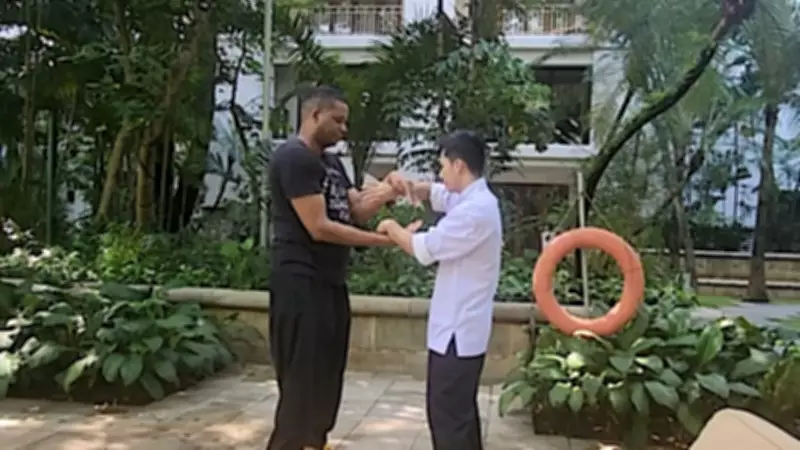
Martial Arts Lineages Converge in Quiet Jakarta Cross-Training Exchange
In the residential district of Kebayoran Baru, South Jakarta, a private garden in Dharmawangsa served as an unexpected venue for a cross-continental martial arts exchange, where stillness heightened precision and discipline took center stage. Removed from the city's typical intensity, the enclosed garden—adorned with trees and filled with birdsong—created a controlled environment dedicated to technical refinement. This setting facilitated a focused session of Chi Sao, a Wing Chun training method that prioritizes sensitivity, timing, and close-range responsiveness.
Practitioners from Distinct Traditions
Ade Olufeko, a Nigerian-American martial artist also known as Fu Qingyun, represented a system influenced by the Moy Yat lineage of Ip Man. As the founder of The Wing Chun Foundation Lagos, his approach emphasizes structured efficiency and direct engagement, with an increasing focus on youth development in Nigeria through disciplined, repeatable training frameworks. Opposite him was David Artobelly, also known as Li Dawei, a Jakarta-based practitioner whose background spans Phang Nam and Shaolin traditions. His method favors circular motion, force absorption, and the long-term cultivation of sensitivity.
Chi Sao as a Calibration Exercise
The session was not a competition but a calibration exercise centered on Chi Sao, translated as "sticking hands." This method functions as a continuous feedback loop of action, response, and adjustment under sustained contact. Initial exchanges saw Olufeko applying forward pressure with direct structural intent, while Artobelly absorbed and redirected force through subtle angular shifts. As the session progressed, both practitioners alternated between advancing and yielding, compressing distance or expanding space as timing dictated.
Corrections were minimal and precise, involving adjustments to stance, hand positioning, and entry angles before contact resumed. Iteration, rather than instruction, drove the learning process. Despite differences in experience, dominance was intentionally absent. Artobelly regulated intensity to maintain what practitioners describe as "productive stress," ensuring the exchange remained a tool for refinement rather than competition.
Emphasis on Responsiveness and Control
Observers noted that in this controlled setting, pressure did not signify aggression but revealed structural integrity. The focus stayed on responsiveness, not force. The collaboration highlighted a broader principle within martial arts training: value stems from constraint and adaptation, not hierarchy. Two distinct lineages, operating within a shared system, resulted not in a conclusion but in a measurable increase in sensitivity and control.
In a city characterized by motion, the work in Dharmawangsa remained deliberately quiet—its impact confined to the discipline of the practitioners involved.