NASA's Artemis II Astronauts Share Stunning Earth Images from Halfway to Moon
NASA has unveiled a breathtaking collection of high-resolution photographs of Earth captured by the Artemis II crew after they reached the critical halfway point between our planet and the Moon. The space agency described these images as "spectacular" visual records of this historic journey.
Historic Milestone in Space Exploration
The photographs were taken by mission commander Reid Wiseman following a successful trans-lunar injection burn, a crucial engine maneuver that propelled the Orion spacecraft out of Earth's orbit and onto its precise trajectory toward the Moon. At the time these images were captured, NASA tracking data showed the Orion spacecraft positioned approximately 142,000 miles from Earth and about 132,000 miles from the Moon.
Astronaut Christina Koch revealed that the moment of reaching this halfway milestone was met with powerful emotions from the entire crew. "We shared a collective expression of joy when mission control informed us we had reached the halfway mark," Koch reported, noting this achievement came just over two days after their launch from Kennedy Space Center.

Spectacular Views from Deep Space
One of the most striking images released by NASA, titled "Hello, World," captures the Atlantic Ocean stretching across the frame with Earth's atmosphere glowing brilliantly as our planet partially blocks sunlight. The photograph reveals stunning green auroras shimmering near both polar regions and presents Earth in an inverted orientation that shows:
- Parts of the western Sahara desert and Iberian Peninsula on one side
- The eastern region of South America on the opposite side
- The planet Venus visible as a bright object in the frame
Another intimate photograph taken from inside the Orion capsule shows Earth through one of the spacecraft's windows, offering a personal perspective of our planet from deep space.
Astronauts Captivated by Unprecedented Views
Mission specialist Jeremy Hansen communicated to mission control that the crew had been completely transfixed by the views outside their windows. "We are getting a beautiful view of the dark side of the Earth, lit by the Moon," Hansen reported with evident wonder.
Commander Wiseman later contacted mission control with a humorous request about how best to clean the spacecraft's windows, joking that the crew's enthusiastic observation of space had left them smudged from constant viewing.
Technical Challenges and Photographic Triumphs
Wiseman initially encountered difficulties photographing Earth from such an extraordinary distance, noting the challenge of adjusting camera exposure settings properly. "It's like walking out back at your house, trying to take a picture of the Moon," he explained. "That's what it feels like right now."
Despite these initial challenges, subsequent images achieved remarkable clarity, including:
- A dramatic view of the terminator line marking the boundary between day and night across Earth
- An image showing Earth almost entirely in darkness with city lights faintly visible
- Clear comparisons with similar photographs taken during the Apollo 17 mission in 1972
NASA highlighted the technological progress made over the past 54 years while emphasizing one constant truth. "We've come so far in the last 54 years, but one thing hasn't changed: our home looks gorgeous from space!" the agency stated in their release.
Historic Mission Path and Significance
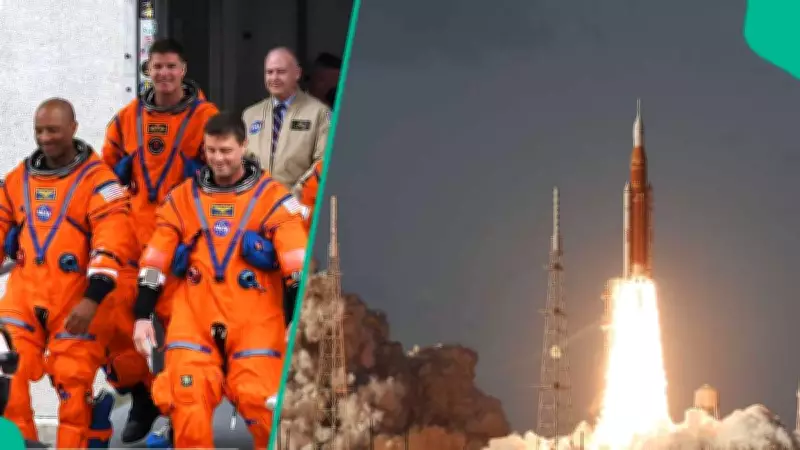
The Artemis II mission represents the first time humans have traveled beyond Earth's orbit since the Apollo 17 mission in 1972. The Orion spacecraft, launched from Kennedy Space Center, is expected to complete a loop around the far side of the Moon before returning to Earth, with splashdown scheduled in the Pacific Ocean.
This mission marks a crucial step in NASA's Artemis program, which aims to return humans to the lunar surface and establish sustainable exploration as preparation for future missions to Mars. The images shared from the halfway point provide not only scientific data but also powerful visual reminders of Earth's beauty and fragility as seen from the depths of space.