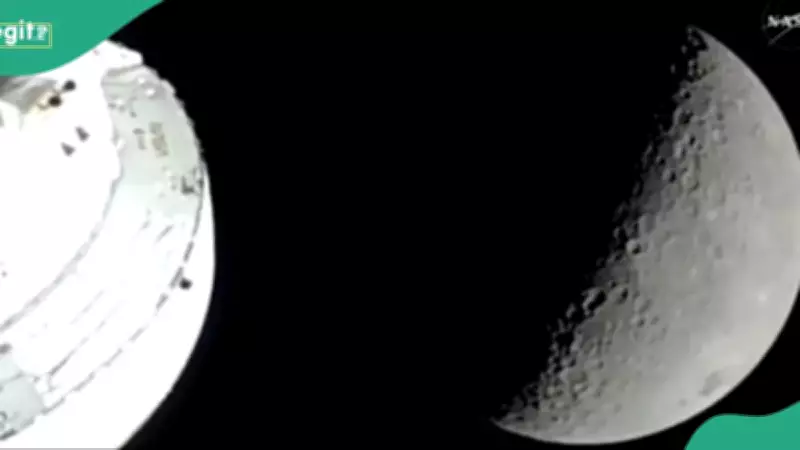
Artemis II Crew Returns to Earth After Historic Lunar Mission
The Artemis II crew is now en route back to Earth following a groundbreaking lunar fly-by mission that saw them travel farther from our planet than any humans in recorded history. The NASA astronauts completed their journey after the Orion spacecraft reached an unprecedented distance of 252,756 miles from Earth, officially surpassing the previous record set by Apollo 13 in 1970, which stood at 248,655 miles.
Record-Breaking Distance and Communication Blackout
Mission control experienced a day filled with both intense activity and remarkable achievements as the astronauts orbited past the Moon. During this critical phase, the spacecraft temporarily lost contact with Earth for approximately 40 minutes while passing behind the lunar surface, an event that was fully anticipated and planned by NASA engineers.
Upon re-establishing communication, mission specialist Christina Koch transmitted the message, "Houston, Integrity, comms check," and expressed relief, stating it was "so great to hear the Earth again." It was during this period behind the Moon that Orion achieved its maximum distance, setting a new benchmark for human spaceflight.

Scientific Observations and Solar Eclipse
The crew made significant scientific contributions during their mission, including observing a total solar eclipse from their unique vantage point. They photographed the celestial event and provided detailed descriptions to NASA scientists stationed in Houston. Dr. Nicola Fox, NASA's head of science, described the observation as "surreal" and commended the astronauts for their precise reporting and valuable scientific work.
Return Journey and Gravity-Assisted Trajectory
The return journey to Earth is expected to take approximately four days, with a scheduled splashdown in the Pacific Ocean off the west coast of the United States at 20:07 eastern time on April 10. Helicopters will retrieve the astronauts and transport them to a nearby Navy ship for comprehensive medical evaluations before they proceed to shore.
Retired astronaut Terry Virts explained the physics behind Orion's return trajectory, noting that the spacecraft relies on the Moon's gravity to slingshot back toward Earth. "They are in deep space with no way to be rescued, experiencing the harshest radiation that doesn't exist on Earth, surrounded by instant death just a few millimeters outside that thin aluminum shell," Virts stated. "Sir Isaac Newton is in charge—gravity is maneuvering the capsule now."
Future Missions and Broader Space Exploration Goals
The Artemis II mission represents a crucial component of NASA's long-term strategy to establish a sustained human presence on the Moon. Dr. Fox revealed that Artemis IV, scheduled for launch in early 2028, will return humans to the lunar surface for the first time since 1972, laying essential groundwork for eventual missions to Mars.
As of 09:30 BST, the spacecraft remained approximately 244,200 miles from Earth. By mission completion, the crew will have traveled more than 695,000 miles in total, marking a significant milestone in human space exploration history.
Photographic Documentation of Earth
In related developments, NASA has released a series of high-resolution images of Earth captured by the Artemis II crew after reaching the halfway point between our planet and the Moon. Mission commander Reid Wiseman took these photographs following a crucial engine burn that properly aligned the Orion spacecraft on its course toward the Moon. NASA officials have described these images as "spectacular" visual records of our planet from deep space.