
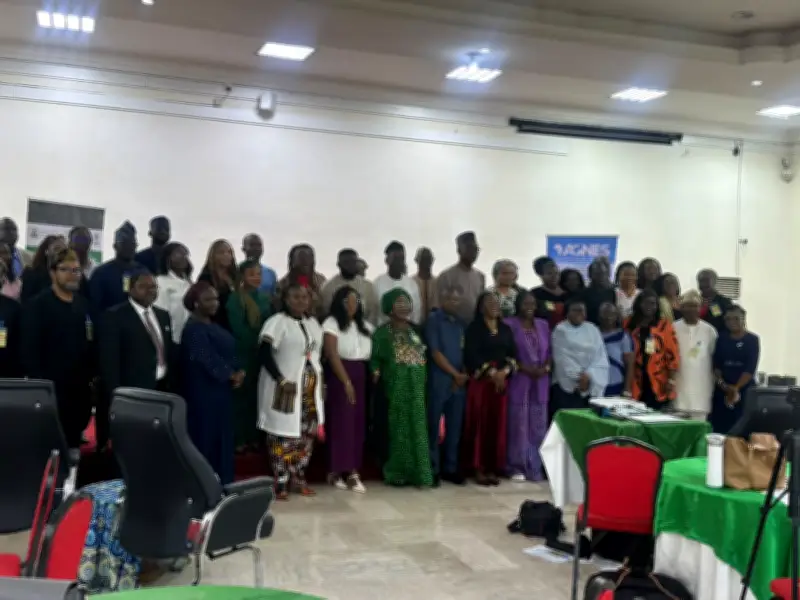
The African Group of Negotiators Experts Support (AGNES) has called on the Nigerian government to fast-track the nationwide rollout of clean cooking initiatives, emphasizing that scaling up electric cooking (e-cooking) is critical for public health, emissions reduction, and fulfilling the country's climate commitments. The appeal was made on Thursday by AGNES Nigeria Country Director David Awolala during the official kickoff workshop for the project “Integrating E-Cooking in Nigeria’s Clean Cooking Policy Implementation Plan and Funding Proposals” in Abuja.
Project Collaboration and Objectives
The project is being implemented in partnership with the Federal Ministry of Environment, the Presidency’s National Council on Climate Change (NCCC), the Federal Ministry of Power, the Climate and Clean Air Coalition (CCAC), and the United Nations Environment Programme (UNEP). AGNES is a continental, not-for-profit African think tank that works at the nexus of climate science, policy, and practice to advance evidence-based negotiations and climate action. Established in 2015 to provide technical support to the African Group of Negotiators (AGN) and African governments, AGNES is a leading continental hub for climate policy, negotiations, and implementation. It is accredited by UNEP and the Intergovernmental Panel on Climate Change (IPCC).
Call for Accelerated Implementation
In his remarks, Mr Awolala stated that although Nigeria has made progress in climate action and energy transition, the country must move beyond policy commitments to large-scale implementation. “The scale of the clean cooking challenge requires accelerated implementation, stronger coordination, and increased investment,” he said. “It requires that clean cooking solutions are not only discussed in policy terms, but are translated into programmes, projects, and financing instruments that can reach households and communities at scale.”
Health and Environmental Impact
Mr Awolala noted that millions of Nigerian households continue to depend on fuelwood, charcoal, kerosene, and other polluting fuels, exposing families to severe health risks while contributing to environmental degradation and greenhouse gas emissions. He said the burden falls disproportionately on women and children, who spend long hours collecting fuel and are most exposed to household air pollution. “These challenges affect productivity, education, health, and economic opportunity. They also contribute to environmental degradation, greenhouse gas emissions, and short-lived climate pollutants,” he added. He argued that clean cooking should no longer be viewed solely as a household energy issue, but as a national development priority spanning the environment, health, energy, gender, finance, and climate sectors.
Opportunities and Barriers for E-Cooking
According to AGNES, electric cooking presents an opportunity to reduce household air pollution, improve energy efficiency, reduce dependence on traditional biomass fuels, and stimulate economic opportunities across appliance manufacturing, distribution, electricity access, and after-sales services. However, Mr Awolala warned that widespread adoption would depend on government action to address key barriers. “E-cooking will not scale automatically,” he said. “Its success will depend on affordability, reliability of electricity supply, consumer awareness, suitable appliances, enabling policy frameworks, innovative financing, market development, institutional coordination, and strong stakeholder ownership.”
Climate Finance and Carbon Markets
The organisation also stated that expanding e-cooking could enable Nigeria to access additional climate finance through carbon markets. According to Mr Awolala, replacing high-emission cooking fuels with cleaner alternatives can generate measurable emission reductions that could qualify for carbon credits under credible standards. “This can help unlock additional climate finance, attract private sector investment, support project sustainability, and create new revenue streams for scaling clean cooking solutions across the country,” he said. He noted that Nigeria’s recently established Carbon Market Framework, signed in 2025 and approved during the 2026 Abu Dhabi Sustainability Week, provides an opportunity to mobilise investment for clean cooking initiatives. The framework establishes the institutional and regulatory structure for Nigeria’s participation in domestic and international carbon markets under the Climate Change Act and Article 6 of the Paris Agreement.
Workshop Goals and AGNES Support
Mr Awolala said a well-designed national e-cooking programme could leverage these opportunities to reduce the cost burden on households while supporting local enterprises. “The purpose of today’s workshop is clear. We are here to officially launch this project, identify opportunities and barriers, agree on practical entry points for implementation, and prepare strong, investment-ready proposals to attract climate finance, clean energy finance, and other relevant sources of support,” he stated. He added that AGNES would provide technical support to help national institutions translate clean cooking policies into implementable and finance-ready programmes. He also announced that AGNES officially opened its country office in Nigeria in Abuja on 1 July 2026.
Government Perspective
Amudi Chioma, the NDC & LT-LEDs desk officer at the Nigeria Climate Change Council, who represented the council’s Director General, said the event was timely, following the conclusion of the sixty-fourth sessions of the Subsidiary Body for Scientific and Technological Advice (SBSTA) and the Subsidiary Body for Implementation (SB64). She noted that it is important for parties to recognise that e-cooking is a vital measure for mitigation and sustainable development. “E-cooking will strengthen the implementation of Nigeria’s NDC 3.0, as we have identified measures under that sub-sector,” she said. The NCCC official argued that the swift adoption of clean cooking will also help achieve the health sector targets enshrined in Nigeria’s NDC 3.0.




