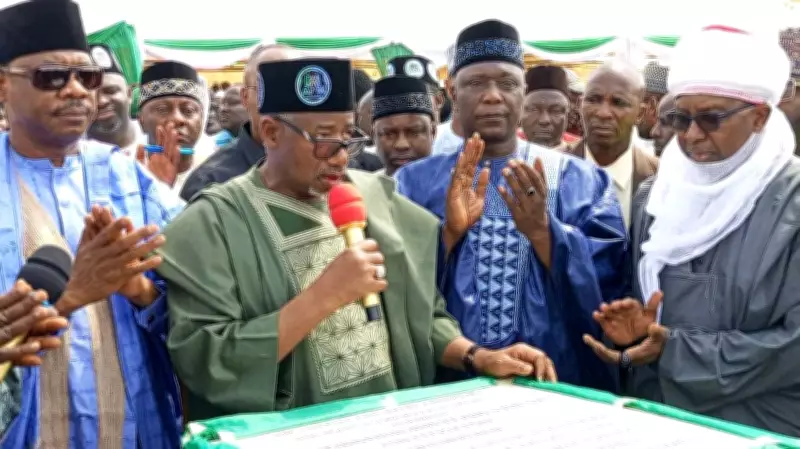
The Bauchi State Government has officially commenced the construction of a N29.69 billion erosion control project under the Agro-Climatic Resilience in Semi-Arid Landscapes (ACReSAL) initiative. The project, funded by the World Bank and implemented in collaboration with the Federal Government and Bauchi State, was inaugurated on Wednesday by Governor Bala Mohammed.
Project Scope and Impact
Speaking at the inauguration ceremony, Governor Mohammed highlighted that gully erosion and uncontrolled stormwater channels from Tsohon Kamfani to Gwallagan Mayaka communities in Bauchi metropolis have significantly altered the town's topography. The project aims to restore 9,842 hectares of degraded land and provide protection for over 213,000 residents.
Funding and Mobilization
The governor confirmed that the state government has already paid 40% of the contract sum as mobilization to the contractor, with the full amount readily available. He emphasized that the contractor has no excuse for not completing the project on schedule.
“This event is far more than the commencement of a construction project; it represents another bold milestone in our administration’s commitment to sustainable development, environmental protection, urban renewal, public health, economic growth, and the well-being of our people,” Mohammed stated.
Urban Renewal and Climate Resilience
The intervention is a key component of the Bauchi Urban Renewal Project and aligns with Bauchi Project II, which focuses on modernizing infrastructure and building climate-resilient communities. The governor noted that what began as small stormwater pathways has expanded into erosion corridors up to 60 meters wide and 50 meters deep, destroying homes, farmlands, roads, and livelihoods.
Community Involvement
Governor Mohammed acknowledged the support of the World Bank, the Federal Government, and the ACReSAL project team led by State Project Coordinator Dr. Ibrahim Kabir. He stressed the importance of community involvement in implementation and monitoring, stating, “Deepening stakeholding means ensuring that those you think are nothing are part and parcel of project implementation and monitoring and evaluation.”