
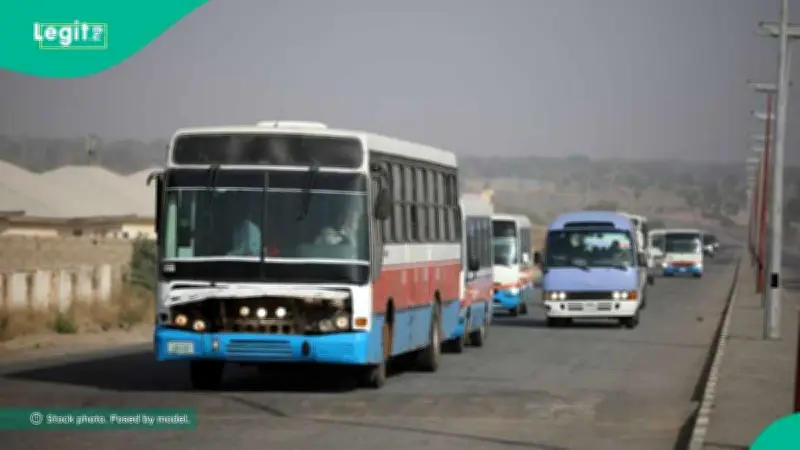
The National Bureau of Statistics (NBS) has reported that the average fare for city bus journeys in Nigeria increased to N1,431.25 in May 2026, marking a 2.43% rise from N1,397.27 in April 2026. Year-on-year, city bus fares surged by 38.63% compared to N1,032.46 in May 2025. For intercity bus travel, the average fare stood at N9,699.55, up 0.96% from N9,607.41 in April 2026 and 21.89% higher than N7,957.41 in May 2025.
State Disparities in Bus Fares
The NBS data revealed significant variations across states. Ondo State recorded the highest intercity bus fare at N11,080.00, followed by Abia at N11,066.13. Kwara State had the lowest intercity fare at N7,969.29, with Edo at N8,000.61. For city journeys, Zamfara State topped the list at N1,878.80, while Taraba came second at N1,771.96. Abia recorded the lowest city bus fare at N890.05, followed by Adamawa at N918.47.
Regional and National Trends
Regionally, the South-West had the highest average intercity bus fare at N10,138.80, closely followed by the North-West at N10,083.57. The South-South region recorded the lowest average at N9,266.49. Among the top ten highest intercity fares, Ondo led, followed by Abia (N11,066.13), Abuja (N11,024.94), Ogun (N10,863.88), and Kaduna (N10,683.72). The lowest intercity fares were in Kwara, Edo (N8,000.61), Bayelsa (N8,300.59), Bauchi (N8,700.46), and Ebonyi (N8,756.12). For city bus fares, Zamfara led, followed by Taraba (N1,771.96), Lagos (N1,741.43), Enugu (N1,664.09), and Osun (N1,651.78). The lowest city fares were in Abia, Adamawa (N918.47), Kano (N1,066.00), Rivers (N1,187.78), and Sokoto (N1,195.66).
Impact on Commuters
The rising bus fares reflect broader inflationary pressures on transportation costs in Nigeria. The NBS report underscores the financial burden on commuters, with both city and intercity journeys becoming more expensive. The data also highlights the uneven impact across states, with some regions experiencing significantly higher costs than others.




