
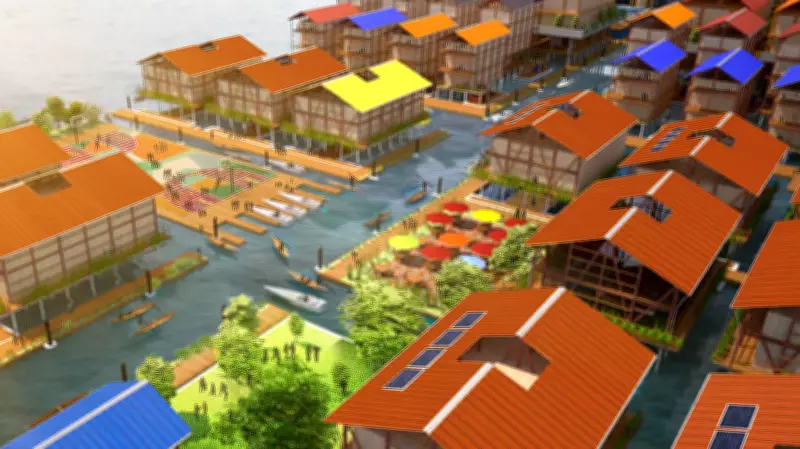
Civil Society Group Rejects Lagos Waterfront Relocation Plan, Backs Regeneration Project
A civil society organisation, Rethinking Cities, has firmly rejected a recent recommendation by the Lagos State House of Assembly to relocate residents displaced by demolitions in waterfront communities. The proposal, which emerged from the Assembly's Committee on Rules and Business, suggests moving affected individuals from areas like Makoko, Oko-Agbon, and Sogunro to a proposed low-cost housing estate in Agbowa, Epe.
The group issued a strong warning that this relocation plan would push long-established and vulnerable communities to the distant outskirts of Lagos. Such a move, they argue, would sever residents from their livelihoods, markets, social networks, and the economic opportunities available within the city. According to Rethinking Cities, many residents of Makoko are multi-generational fishers and traders whose survival hinges on their proximity to the lagoon and access to water-based livelihoods.
Relocating these residents to a distant inland location would not only disrupt their economic activities but also worsen their living conditions significantly. The group contends that this plan reflects a recurring pattern in urban planning across many African cities, where low-income communities are often pushed to the periphery in the name of development.
Outdated Approaches and Deepening Inequality
Deji Akinpelu, Co-Founder of Rethinking Cities, stated that the proposal embodies outdated approaches to urban development that prioritise elite visions of the city over the rights and realities of vulnerable communities. He emphasised that forced relocations rarely solve urban challenges and often deepen social inequality.
"We have witnessed this cycle of exclusion too often in Lagos and across African cities. Such relocations do not solve urban challenges; they compound inequality, erode community cohesion and undermine the principles of inclusive and sustainable urban development," Akinpelu said.
The organisation highlighted that relocating residents far from essential resources inflicts immediate hardship and perpetuates a dangerous cycle. In this pattern, governments displace the urban poor to remote areas today, only to evict them again tomorrow when development reaches those same peripheries.
Advocating for the Makoko Water City Regeneration Project
Instead of supporting the relocation plan, Rethinking Cities has urged the Lagos State House of Assembly to withdraw the recommendation. The group calls for collaboration with the executive arm of government to accelerate the implementation of the proposed Makoko Water City Regeneration Project.
This initiative, championed by the administration of Babajide Sanwo-Olu, is presented as a more inclusive and sustainable approach to addressing the challenges faced by waterfront communities. The project focuses on in-situ upgrading, allowing residents to remain within their communities while improving housing conditions and essential infrastructure.
Key aspects of the regeneration strategy include:
- Committing about $10 million to improve living conditions in Makoko through safer housing designs, better sanitation systems, improved drainage, and more regulated waterways.
- Preserving the fishing economy that supports thousands of families living in the community.
- Investing approximately $2 million already by the Lagos State Government, with additional funding support expected from the United Nations to scale up the project.
The group noted that this regeneration strategy offers a more humane and environmentally responsible solution by upgrading the community in place rather than displacing residents to distant locations.
Call for Participatory Planning and Solidarity
Rethinking Cities also called for direct engagement with community leaders, residents, and civil society organisations to ensure that any regeneration initiative benefits those who currently live and work in Makoko. Akinpelu reaffirmed the organisation's commitment to promoting inclusive urban policies that protect the rights of low-income residents and discourage forced evictions without adequate alternatives.
"We stand in solidarity with the people of Makoko and call on all stakeholders to prioritise dignity, livelihoods and belonging over displacement," he said.
He added that sustainable urban development must involve participatory planning that recognises the social, economic, and cultural realities of communities rather than imposing top-down relocation schemes. This approach, the group argues, is essential for fostering genuine progress and equity in Lagos's urban landscape.




