
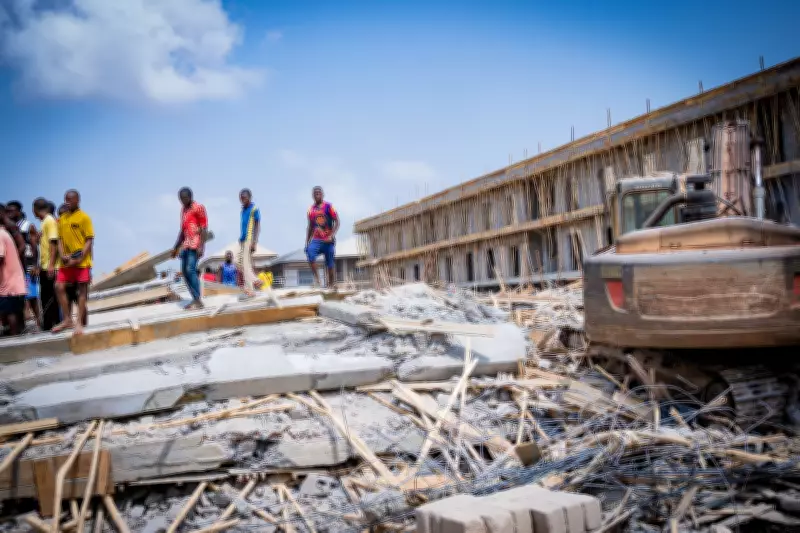
Building Collapse Prevention Guild Advocates for Early Warning Systems After Lagos School Incident
The Building Collapse Prevention Guild (BCPG) has emphasized the critical need for proactive early warning systems in Nigerian buildings to prevent fatalities during construction failures. This urgent call follows the collapse of a school building at Yemco Schools, located at 11, Adu Street, Aguda, Ogba, within the Ojodu Local Government Council Development Area (LCDA) in Lagos, on Monday, March 9, 2026. Fortunately, all pupils and staff were successfully evacuated during the incident, showcasing how timely alerts can avert loss of life.
Early Signs of Building Failure Highlighted by Guild
In a joint statement issued yesterday, key BCPG officials, including Coordinator Abiodun Adegoke of the Ojodu Cell, General Secretary Dom Ibeh, and Public Relations Officer Femi Ishola, detailed that buildings often display clear warning signs before collapse. According to the Guild, indicators such as concrete spalling, visible cracks in walls or columns, bulging surfaces, unusual vibrations, and deflection of floors or beams provide a crucial window for intervention. These signs can enable building managers and occupants to take preventive actions before catastrophic failures occur.
The Guild noted that this recent collapse at the four-storey Yemco school building in Ogba, Ojodu, occurred just four days before the seventh anniversary of a similar tragedy. On Wednesday, March 13, 2019, a five-storey Ohen school building at 63, Massey Street, Ita-Faaji, Lagos Island, collapsed, resulting in the deaths of about 20 pupils and numerous injuries. Feedback from the BCPG Lagos Island Cell revealed that pre-collapse cracks, concrete spalling, and accompanying sounds were observed in the Ohen building on that fateful day, but evacuation was not possible in time.
Modern Technology and Policy Recommendations
The narrow escape at Yemco Schools has sparked a renewed call for the installation of advanced early warning systems in buildings. The Guild explained that modern building collapse detection systems, enhanced by Internet of Things (IoT) technology, can take safety to the next level. IoT-enabled sensors embedded in structural components continuously monitor stress, movement, and deflection. When a building exceeds safe thresholds—such as when beams deflect, columns buckle, or vibrations increase—alarms are triggered, alerting occupants and managers to evacuate immediately.
Building occupants are urged to remain vigilant and report early signs of distress. High-occupancy structures, including schools, hospitals, and multi-storey residential complexes, should be prioritized for these systems. The Guild stressed that the recent collapse at Aguda Ogba serves as a vital lesson: detecting tell-tale signs and equipping buildings with early warning systems can save lives. They called on building owners, managers, and regulators to adopt smart monitoring devices in all high-risk buildings to enable real-time alerts, timely evacuations, and a safer urban environment across Nigeria.
Additionally, the BCPG recommended diligent investigations into the Yemco school building collapse to establish the real causes and prevent recurrence. They also urged the Lagos State Government to act swiftly on distressed buildings, such as the three-storey school structure at Mainland Senior High School on Onayade Street, Fadeyi, Yaba, which was officially reported by the BCPG Yaba Cell on January 28, 2026. The Guild reaffirmed its commitment to collaborating with government agencies, regulatory authorities, and stakeholders in the built environment to promote safer buildings and prevent avoidable collapses nationwide.




