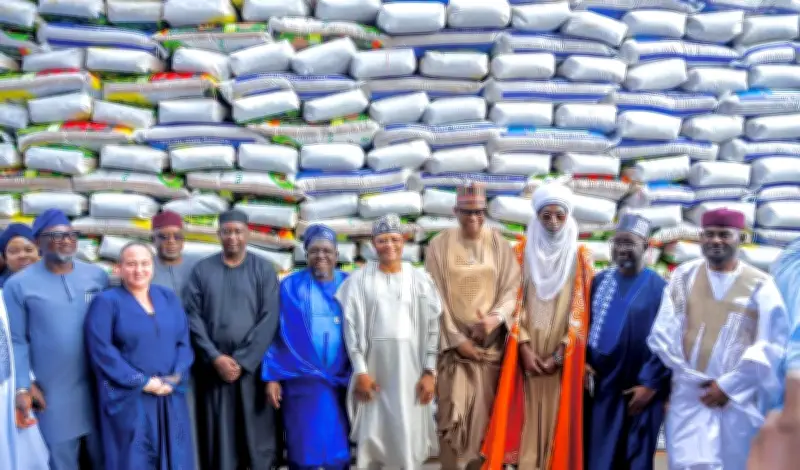
Governor Uba Sani of Kaduna State on Saturday launched the distribution of 500 trucks of free fertiliser and deployed tractors to support 150,000 smallholder farmers across the state's 23 local government areas. This marks the third consecutive year the administration has undertaken such an intervention.
Background of the Fertiliser Support Programme
The event, held at Murtala Mohammed Square in Kaduna, builds on previous programmes. In 2025, the government distributed 400 trucks of free fertiliser to 100,000 farmers, with each receiving two bags. In 2024, the state executed what it called its largest-ever fertiliser distribution, providing over 500 trucks alongside other inputs for dry-season farming.
Speaking at the launch, Governor Sani described the initiative as "one of the most extensive fertiliser support programmes undertaken by any subnational government in Nigeria." He said the programme aims to cushion the impact of rising production costs on farmers and prevent reduced cultivation, lower yields, and worsening food insecurity.
Rejection of Subsidised Sale Model
The governor revealed that he was advised to sell the fertiliser at subsidised rates but rejected the proposal. "For example, if we buy the commodity at ₦56,000 per bag, we should sell it to farmers at ₦20,000. But ₦20,000 is still beyond the reach of most smallholder farmers. Besides, large-scale farmers could buy up the commodity and resell it at exorbitant prices, defeating the purpose of the subsidy," he explained.
Agriculture as Economic Backbone
Governor Sani noted that agriculture now contributes about 43 per cent of Kaduna's Gross Domestic Product (GDP) and employs between 60 and 80 per cent of the active workforce. He attributed renewed farming activities to improved security, stating that thousands of farmers have returned to their lands. With cooperation from residents and support from President Bola Tinubu, the state has reclaimed 5,000 hectares of farmland previously affected by insecurity.
Kaduna remains Nigeria's leading producer of maize, tomatoes, and ginger, according to the governor. "Agriculture is far more than an economic sector. It is the meeting point of food security, industrial development, job creation, rural transformation and social stability," he said.
Increased Budgetary Allocation to Agriculture
Since assuming office in 2023, Governor Sani's administration has significantly increased agricultural budget allocations. The sector received ₦1.48 billion (about 0.4 per cent of the state budget) before his tenure. This rose to ₦23.4 billion in 2024, ₦74.02 billion in 2025, and over ₦100 billion in the 2026 budget, representing about 11.65 per cent of total state expenditure—surpassing the 10 per cent benchmark set under the Malabo Declaration.
Comprehensive Agricultural Strategy
The governor emphasised that his administration's agricultural strategy extends beyond fertiliser distribution to include investments across the value chain: improved seeds, mechanisation, irrigation, extension services, affordable financing, agricultural insurance, rural roads, and market access. The state has also strengthened livestock development through veterinary services, disease surveillance, vaccination programmes, dairy and poultry production, feed improvement, and pastoral infrastructure.
More than 100,000 farmers have been enrolled in agricultural insurance schemes to protect against floods, drought, pests, and other risks. Additionally, Kaduna is implementing the Special Agro-Industrial Processing Zone (SAPZ) in partnership with the Federal Government and the African Development Bank. The state is also establishing the Africa Quality Assurance Centre to ensure agricultural products meet international standards under the African Continental Free Trade Area (AfCFTA).