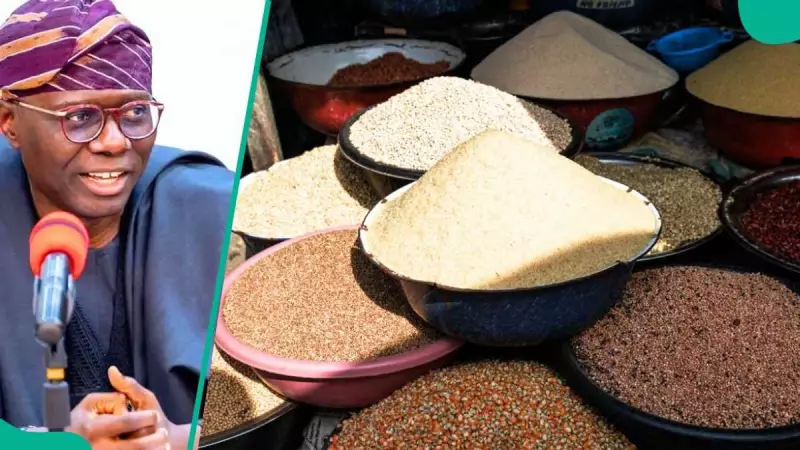
The Lagos State Government has launched a significant 25 percent subsidy on essential food items as Christmas approaches, providing much-needed relief to residents grappling with persistent food inflation across Nigeria.
Commissioner for Agriculture and Food Systems, Abisola Olusanya, announced the intervention during a press briefing in Alausa, Ikeja, revealing that staples including rice, beans, garri, bread, and pepper will be available at reduced prices through the Lagos Fresh Food Hub in Mushin.
Dual Approach to Food Security
This consumer-focused initiative runs alongside the second phase of the Ounje Eko Farmers Subsidy Programme, creating a comprehensive strategy that addresses both production and consumption challenges.
The farmers' programme provides a 25 percent subsidy on poultry and fish feeds, while the state government will also distribute free grains to pig farmers to support livestock nutrition and sustainability.
Commissioner Olusanya emphasized that these measures represent Governor Babajide Sanwo-Olu's commitment to building a food-secure Lagos through strategic partnerships with agricultural producers and distributors.
Proven Success from First Phase
The first phase of the Ounje Eko initiative demonstrated tangible results, directly benefiting over 5,000 farmers across the state.
During that phase, the government supplied 1,000 tons of poultry feed and 300 tons of fish feed, which sustained more than 260,000-layer birds and resulted in the production of over 7 million eggs and 177,000 catfish.
Most notably, the intervention helped reduce the average price of a crate of eggs from ₦6,000 to ₦5,000, demonstrating direct consumer benefits from the agricultural support programme.
Building Long-term Food Resilience
These interventions align with the broader Produce for Lagos Programme, a key component of the state's Food Systems Transformation Agenda designed to create a more resilient agricultural economy.
For horticulture farmers, Lagos will provide tractorization services and distribute fertilizers to boost crop yields, while also monitoring produce off-take and ensuring distribution across major markets at competitive prices.
The timing of these measures coincides with recent economic data showing some improvement, as the National Bureau of Statistics reported that headline inflation eased to 18.02% in September 2025 compared to 20.12% in August.
Commissioner Olusanya concluded that by linking farmer support with consumer relief, Lagos is setting the pace for sustainable food systems that other Nigerian states could emulate, particularly during challenging economic periods and festive seasons when financial pressures typically increase.